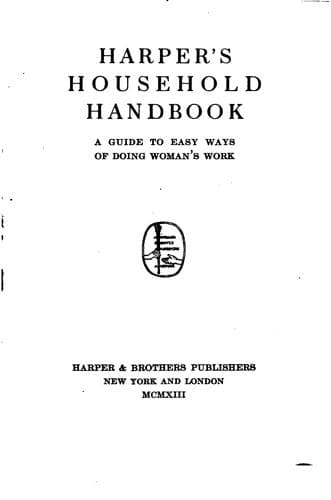
Harper's Household Handbook: A guide to easy ways of doing woman's workMcCulloch-Williams, Martha
General
Harper's Household Handbook: A guide to easy ways of doing woman's work
McCulloch-Williams, Martha
Formulas, recipes, etc.; Home economics
=Cutting Out:= Spread plain-surfaced things, as silk, linen, serge, and
lighter woolens, double upon the table, which must be at full length.
Lay on patterns, having regard to warp and woof threads. Let warp run up
and down, woof around. In cutting a bodice the woof threads should make
a sort of belt. Thus they pull true, and the seams are an easy bias. Lay
on the whole pattern as nearly as space allows, and study economy of
material in arranging the pieces, but not at the cost of getting threads
wrong. Cut with sharp shears, taking care to allow for seams when
requisite. Lay off pieces as cut out, but keep the cloth steady by means
of light weights. Patterns are best pinned in place, but with long
lines, as skirts or draperies, books laid on as weights are better,
besides being easier.
Things with a nap, as broadcloth and corduroy, must not be cut with
cloth double from each end. If the goods is double-fold, cutting double
is desirable. Otherwise cut so the nap runs the same in each piece. This
also applies in case of figured stuffs with a decided up and down. To
make a waist or coat pattern smaller lay a crosswise plait from armhole
to edge, and cross it with a lengthwise one of equal width. Enlarge a
pattern by cutting it across instead of plaiting it and pasting in
strips of paper. Alter skirt lengths usually at the bottom; either fold
up or allow extra. If too wide, fold down along each edge to keep
proportions.
=Basting:= Baste shoulder seams with the upper half of the fronts
stretched tight, the back held a little full. Pressing heals the
puckers, which give the smooth fit over the hollow of the shoulder not
otherwise attainable. Use fine firm thread for basting, with a
large-eyed needle. Take medium running stitches in seams to be fitted;
with edges to be held for sewing together make the stitches very long,
and set them so far back the stitching will not catch them.
=Pressing:= Have a small board covered with flannel, then with muslin,
for pressing. An alcohol stove for heating irons saves time and trouble.
Keep it with the iron inside a handy box, upon which it can be set when
lighted. Do not damp woolen things before pressing. Moisten silk very
slightly, linen rather more, and cotton, as in linings, most of all.
Press rounding seams, such as armholes and rolling collars, over the end
of the board. Press sleeve seams with the small end of the board inside.
Sew up and press outer sleeve seams before sewing inner ones. Do the
same with very tiny trousers. Where pressing must be done on the right
side cover with a thin cloth very slightly dampened.
Public-domain text, read in full here on John Shaqi.
Reviews
Reviews
No reviews yet
Be the first to share your thoughts on this work.
Join the Discussion
Join the discussion
Sign in to leave a comment or review.
Sign InorCreate an account