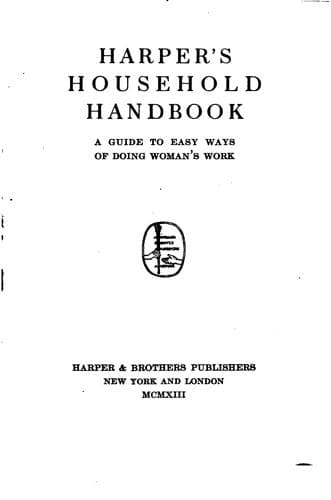
Harper's Household Handbook: A guide to easy ways of doing woman's workMcCulloch-Williams, Martha
General
Harper's Household Handbook: A guide to easy ways of doing woman's work
McCulloch-Williams, Martha
Formulas, recipes, etc.; Home economics
=Laundry Aprons:= Make laundry aprons of strong stuff, but sleazy—crash,
denim, or colored linen. Cut kimona shape, with roomy sleeves, and to
slip on over the head. Set a deep pocket on each side, within handy
reach. Set a smaller pocket across the front just below the waist. Carry
clothes pins in the big pockets, safety pins, a handkerchief, and
wiping-rags in the other. Make wide enough for free motion, but not
enough to sag under foot when the wearer stoops. Let come almost to the
instep.
=Ironing-tables:= Make board or table suit your height, so you need
neither stoop at the work nor hunch your shoulders. Set a table too low
upon bricks or blocks—if it is too high, have something stable to stand
on. Make tight-fitting covers for the table of unbleached muslin, sewed
double at one end, to be slipped over the table edge, and with the other
end long enough to lap over and safety-pin firmly in place. Have a
double blanket under the cover, laid very smooth.
In using a board, set it high or low, as your height requires.
=As to Soaking:= Long soaking of clothes is undesirable—it loosens dirt
but passes it throughout the fabric. An hour is sufficient. Cover things
that must stand overnight with cold water rather than hot. Nursery wash
in need of soaking must be kept to itself. So should things from a
sickroom that are badly fouled.
=As to Boiling:= Boiling is not absolutely essential to clean clothes,
still a means of grace toward them. Have separate boiling-bags for table
linen, for handkerchiefs, for fine things like caps and collars. In
boilers the best is the costliest—namely, copper. Next ranks the
cheapest—a deep iron pot. Copper-bottomed tin answers with good usage.
Iron pots will crack if allowed to get very hot before water is put in.
Any boiler should have at least an inch of water in it before going over
the fire. Likewise it must be kept clean, dry, and wash-worthy by
constant vigilance for holes and cracks.
=Irons:= Test by pressing your cheek against the face—if rough, reject.
Five to six pounds is a good weight. Half a dozen will be none too many.
Keep clean and dry. Beware of setting them face down upon live coals or
red-hot iron—heat pits them microscopically, but enough to make them
stick. Polishing-irons are somewhat lighter and rather different in
shape. Have an asbestos pad or wire trivet to set irons on. Have several
holders, if you lack a patent handle, and shift as they grow hot.
Public-domain text, read in full here on John Shaqi.
Reviews
Reviews
No reviews yet
Be the first to share your thoughts on this work.
Join the Discussion
Join the discussion
Sign in to leave a comment or review.
Sign InorCreate an account