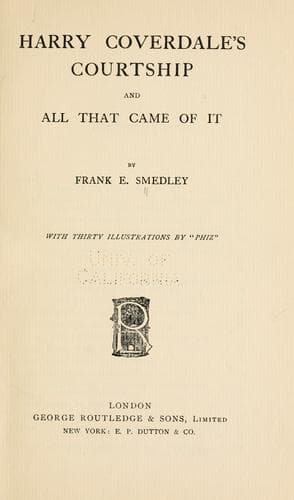
Harry Coverdale's Courtship, and All That Came of ItSmedley, Frank E. (Frank Edward)
General
Harry Coverdale's Courtship, and All That Came of It
Smedley, Frank E. (Frank Edward)
England -- Social life and customs -- 19th century -- Fiction; English fiction -- 19th century
patriarchs had evidently found their prototypes in Mario, Lablache,
and Tamburini--a fact which afforded Horace D’Almayne an opportunity of
observing that it was charming to perceive in England the amiability of
the Muses; as Apollo, the divinity of painting, instead of being driven
to rugged nature for materials, or, worse still, compelled to fall back
upon his own powers of invention, was obligingly supplied with them by
Melpomene and Thalia; which same he and Mr. Crane thought a very smart
saying--the former because he had made it himself, the latter because he
did not understand it.
As they strolled on through the gallery, Kate took an opportunity, when
Mr. Crane had relinquished her arm, in order to adjust his great-coat
more to his satisfaction, to lag behind a few paces, glancing at
D’Almayne as she did so, who immediately joined her.
“I have made the inquiry you wished,” he said in a low tone, “and I
am truly glad to be able to assure you your sympathy has fallen on a
deserving object; the poor woman is as she represented herself--a widow,
with a family of young children depending upon her for support, and her
poverty is extreme.”
“Many thanks for taking so much trouble,” returned Kate, in a tone of
voice more cordial than she generally used towards her companion; “and
now tell me how best I can assist them.”
“I have a plan, but can scarcely give you the details here; when would
it be agreeable to you to”--(here his eye rested for a moment on Mr.
Crane, contending with a button-hole)--“to resume the subject, and give
me your opinion on my scheme?”
Kate reflected a moment, during which she struggled with an instinctive
feeling, and deeming it reasonless, conquered it, then replied--
“If you should be disengaged at eleven o’clock to-morrow, and would look
in, I should be very much obliged to you.”
While this conversation passed between Kate and D’Almayne, they had
been themselves the subjects of observation to a party of strangers,
who, coming probably from the country, had not yet attuned their voices
to the requirements of London sightseeing. Accordingly, the following
remarks were distinctly audible to those for whom, of all others, they
were not intended.
“What a lovely young woman!” observed Mater Familias; “I suppose the
mustachioed gentleman is her _futur_.”
“She don’t look over loving at him, if he is,” grumbled Pater F.
“Perhaps that is because her father (regarding Mr. Crane) is so close,
and does not approve of the match,” suggested Sarah Jane, the eldest
daughter, to Louisa Anne, her sub----
“_Au contraire_,” remarked the intelligent London cousin, a clerk in
the Ignorance and Delay Office, who was popularly supposed to
know everything and everybody; “the old boy is a rich Manchester
cotton-spinner, and the young lady his wife; she married him for his
tin, and half London is raving about her beauty.”
“Poor thing!” muttered Mater Familias, who, for fifty-two, was
unusually romantic--“poor thing, how I pity her!”
Public-domain text, read in full here on John Shaqi.
Reviews
Reviews
No reviews yet
Be the first to share your thoughts on this work.
Elsewhere in the archive
Join the Discussion
Join the discussion
Sign in to leave a comment or review.
Sign InorCreate an account