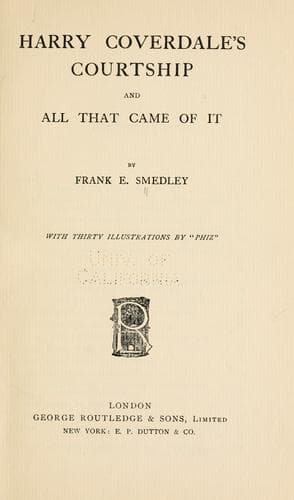
Harry Coverdale's Courtship, and All That Came of ItSmedley, Frank E. (Frank Edward)
General
Harry Coverdale's Courtship, and All That Came of It
Smedley, Frank E. (Frank Edward)
England -- Social life and customs -- 19th century -- Fiction; English fiction -- 19th century
Horace _did_ understand; he glanced at Harry’s face. The handsome mouth
was sternly compressed--the small, well-cut nostril quivered, and the
large dark eyes flashed with the anger he could scarcely restrain, his
tall form was drawn up to its full height--his broad chest dilated,
and the muscles stood out on his stalwart arms until their shape became
visible beneath the “Zephyr Paletot;” altogether, Coverdale did not look
just then the kind of man with whom it would be pleasant to quarrel: so
D’Almayne, deeming “discretion the better part of valour,” smiled, and
said something which might mean anything, and conveyed a clear idea of
nothing, in his most fascinating manner, and then piloted his companions
to the spot where he had agreed on a rendezvous at a certain time with
the Crane party. They had not yet made their appearance, however, and
D’Almayne (who, since Harry gave him the “caution” conveyed in his last
speech, had evinced a marked desire to keep on good terms with, and
out of arms reach of, so dangerous an acquaintance), guessing their
whereabouts, volunteered to go and fetch them.
“Pray do not quarrel with that man,” urged Arabella, as D’Almayne
quitted them; “you are as little his equal in scheming and manœuvring,
as he is yours in strength and courage, and for this reason he is more
to be dreaded than if he were a very Hercules; do not lose your temper
with him, for by so doing you will put yourself in the wrong and play
his game; come, be guided by me in this matter; believe me, my only
object is to secure your happiness.”
As she spoke, she looked up in his face with such an expression of
interest, not to say affection, that Coverdale, whose anger at the worst
was always a very evanescent affair, felt an impulse of pity for her,
which appeared in the softened tones of his voice, as he replied:--
“Don’t be afraid; I’m not going to give him his deserts at present, and
I’m very sorry I spoke harshly to you just now; but I know Alice to
be so good, and true, and pure--innocent and spotless as a child (by
heaven, the slightest blow to my faith in her would drive me mad!), and
the mere mention of that foolish boy supposing her to be a fit recipient
for his romantic sentimental nonsense, made me lose my temper: but you
need not fear my doing anything hasty. I shall, as you advise, observe
Alfred Courtland, and if, as I feel certain, his attentions annoy Alice,
I shall speak to him seriously and kindly (I know the boy has a good
heart, and that it is D’Almayne who has set him on this business, if he
_is_ set on it); then, finding I am aware of it, his fancy will die a
natural death; but I have little expectation that my preaching will be
required. Alice’s indifference will work the best cure.”
Public-domain text, read in full here on John Shaqi.
Reviews
Reviews
No reviews yet
Be the first to share your thoughts on this work.
Elsewhere in the archive
Join the Discussion
Join the discussion
Sign in to leave a comment or review.
Sign InorCreate an account