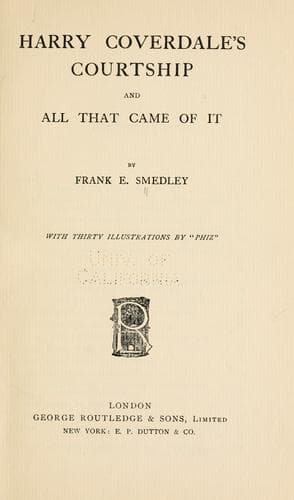
Harry Coverdale's Courtship, and All That Came of ItSmedley, Frank E. (Frank Edward)
General
Harry Coverdale's Courtship, and All That Came of It
Smedley, Frank E. (Frank Edward)
England -- Social life and customs -- 19th century -- Fiction; English fiction -- 19th century
As he spoke, the Crane party came in sight, Kate and her husband leading
the van, closely attended by Horace D’Almayne; while, at some little
distance behind them, lingered Alice on the arm of Lord Alfred
Courtland. As they came up, he was addressing her in an earnest,
pleading manner. Alice appeared thoughtful and _distraite_, but the
moment her eye fell upon Harry and Miss Crofton she started, coloured
up, and turning to her companion, said in a hurried, eager tone--
“Such constancy and perseverance, my lord, deserve rewarding,” and as she
spoke she gave him a rosebud she carried in her hand, which he fastened
in his button-hole with an expression of eager delight.
Alice’s words and action were neither of them lost upon her husband or
his companion.
CHAPTER XXXVI.--ARCADIA IN THE NINETEENTH CENTURY.
It is popularly asserted and believed that everything has two sides
to it. Even a plum-pudding has an inside and an out; and that romantic
malady, yclept “love unrequited,” although at first sight it appears an
entirely one-sided affair, often demonstrates its bilateral capabilities
by proving a much less heart-rending business than was imagined, when
the lapse of time enables one to discern the bright side of the picture.
The Crane expedition to the Horticultural Fête formed no exception
to this law of nature:--thus, at the moment when Harry, like Hamlet’s
unfortunate papa, was having poison poured into his ear, and was
gradually working himself up to the bolster-scene-in-Othello pitch,
Alice, that pleasant little Desdemona, unconsciously amused herself with
Cassio, Lord Courtland, emulating Dr. Watts’s “busy bee,” by flitting
from flower to flower, laughing at very small jokes, and altogether
conducting herself with great levity, and in a singularly undignified
manner--at least, so Mr. Crane thought; and as he was said to be made of
gold, his opinions ought to have partaken of the value of that precious
metal. But Mr. Crane had never quite forgiven Alice for not appreciating
his many excellences, and was disposed to judge her harshly. After a
time, however, when the novelty of the scene began to wear off--when
Alice had reviewed the contents of Howell and James’s, Swan and Edgar’s,
Redmayne’s, and other ruination shops, on the fair forms of the
ladies of the land--when she had “oh-how-beautiful-ed” and
“isn’t-it-lovely-ed” the flowers to her heart’s content--when she had
heard, and longed to dance to, the Guard’s band, suddenly a dark
vision rose to her mind’s eye--her husband _tête-à-tête_ with that evil
mystery, Arabella Crofton, obscured the sunshine of her spirit; the
rose-coloured spectacles through which she had beheld Vanity Fair fell
off; the serpent had entered in; and, for Alice Coverdale, Chiswick was
Paradise no longer. Thereupon she decided that Lord Alfred was a silly,
tiresome boy, and worried her with his childish nonsense; that Mr. Crane
was a fractious old idiot, who ought to be shut up in an appropriate
Public-domain text, read in full here on John Shaqi.
Reviews
Reviews
No reviews yet
Be the first to share your thoughts on this work.
Elsewhere in the archive
Join the Discussion
Join the discussion
Sign in to leave a comment or review.
Sign InorCreate an account