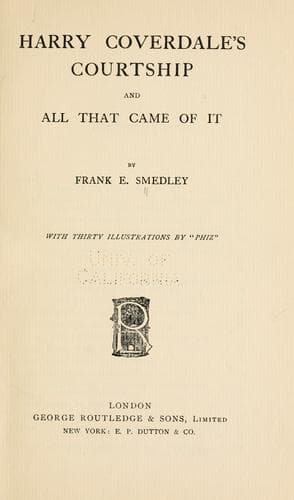
Harry Coverdale's Courtship, and All That Came of ItSmedley, Frank E. (Frank Edward)
General
Harry Coverdale's Courtship, and All That Came of It
Smedley, Frank E. (Frank Edward)
England -- Social life and customs -- 19th century -- Fiction; English fiction -- 19th century
The plan which D’Almayne had settled with Kate was this:--she was
sitting for her portrait to an artist friend of Horace’s, to whose
painting-room she went twice a-week; D’Almayne proposed to send away the
carriage and servants, when he would have a hired brougham in readiness
to convey her to the obscure suburb in which Mrs. Leonard’s poverty
compelled her to reside; he would meet her on her arrival there, and
introduce her to Mrs. Leonard; she could then return to the artist’s,
whence her own carriage could again fetch her and convey her home. Kate
disliked all this clandestine contrivance; but, considering the end of
sufficient importance to justify the means, she was unable to devise any
less objectionable scheme, and so reluctantly consented. She reached her
destination without adventure. The dwelling occupied by Mrs. Leonard was
situated in one of the labyrinths of small, unwholesome streets which
lie between Islington and Pentonville, and contain a description of
houses too good, or, more truly speaking, too expensive, for the very
lowest orders to reside in, and yet so confined and comfortless that
it appears incredible that any persons, accustomed to even the ordinary
requirements of respectable life, can tolerate them. D’Almayne was
waiting in readiness to receive her, and, offering her his arm, led
her up the narrow steps and into a miserable parlour, some eight feet
square, with the same elaborate and coxcombical politeness with which
he would have conducted her across the receiving-room of a duchess. Mrs.
Leonard was a singularly gentle, lady-like person, evidently worn down
by her continued struggle to support herself and family, which
consisted of two boys and three girls, the eldest son and daughter being
respectively fourteen and fifteen, whence their ages decreased down to
a little pale thing of four years old, whose juvenile roses could not
bloom for want of purer air and more nutritious diet. To them, with the
greatest tact and kindness, did Kate proceed to enact the character of
guardian angel; and, ere she had been half-an-hour in the house, had
completely won all their affections, from the poor mother, who began
to see light breaking in upon her darkness, to the olive-branch of
four--whose visions of unlimited sugar-plums bade fair to be realised.
Ah! it is easy to buy golden opinions of the poor and needy in this
world: generosity, _i.e._, judiciously disposing of superfluous cash, is
a virtue strangely overrated. The widow’s mite is an offering for which
one can feel respect, even with a well-filled stomach; but that shrine
for an Englishman’s heart must be indeed empty, ere he can thank Dives
for his crumbs. But, when Kate smiled brightly, and spoke kindly and
tenderly as she opened her purse-strings, what wonder that the inmates
of that house of mourning were ready almost to worship her beauty and
munificence? nay, in the excess of her gratitude, poor Mrs. Leonard so
Public-domain text, read in full here on John Shaqi.
Reviews
Reviews
No reviews yet
Be the first to share your thoughts on this work.
Elsewhere in the archive
Join the Discussion
Join the discussion
Sign in to leave a comment or review.
Sign InorCreate an account