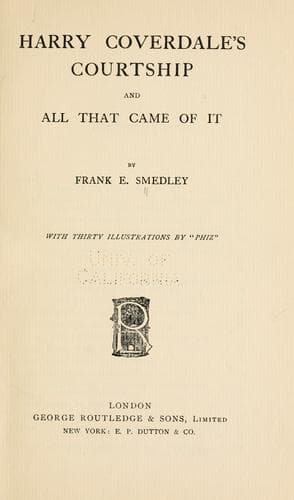
Harry Coverdale's Courtship, and All That Came of ItSmedley, Frank E. (Frank Edward)
General
Harry Coverdale's Courtship, and All That Came of It
Smedley, Frank E. (Frank Edward)
England -- Social life and customs -- 19th century -- Fiction; English fiction -- 19th century
lauded Horace D’Almayne for the sunshine he had caused to fall upon the
“frost of her despair,” that this excellent young man really began to
believe himself to have been actuated by pure philanthropy, and wished
he had not, from disuse, entirely lost the power of blushing. So _he_
talked, and _she_ talked, and _they_ talked, and were all very much
pleased with themselves and with each other; and Kate Crane turned to
depart, with her purse and her heart equally lightened by this most
satisfactory visit. D’Almayne, enraptured alike with the success of his
scheme, and with himself for having so cleverly devised and executed the
same, led Kate to her brougham with nearly as conspicuous a display
of gallantry to the lady, and admiration of himself, as that which
distinguished Lord Bateman’s proud young porter on the memorable
occasion of his playing gentleman usher to the fair Sophia. Having
placed her in the brougham, handed her parasol (why do ladies take
parasols about in carriages, where there is not the most remote chance
of their being required?), and a shawl, and a carriage-bag full of
elegant rubbish, and smirked to show his white teeth three times--once
for each article--he received as a reward a kindly smile (for Kate
really felt obliged to him for the opportunity of doing good which he
had afforded her), which he received with a look of deferential ecstacy,
and the brougham, with its fair occupant, drove off.
On a sordid pallet, in the garret of the house opposite to that in which
Mrs. Leonard resided, lay a man who, having lived wickedly, was then
dying miserably: stricken with remorseful terror at the near approach
of death--inevitable, fearful, retributive death--gate to the stern,
inexorable Future, when he would be weighed in the balance and found
wanting--he had wished, poor wretch! to undo some of the evil he had
committed, and so sent to a rising young barrister, then getting up
evidence in a disputed peerage case, to confess to him the forgery of a
name in a parish-register and other iniquities, the knowledge of which
would materially strengthen the cause of the young lawyer’s client. The
interview, a most painful one to any man of feeling, was concluded;
and, having taken copious notes of the dying forger’s confession in the
presence of a competent witness, soothed the miserable being with
such comfort as human sympathy could suggest, and promised to send
the clergyman who his patient and gentle persuasion had induced him
to receive, the young barrister left the house at the moment D’Almayne
handed Kate Crane to the brougham. Why does the stranger turn first red
then pale? why does he clench his fist till the nails dig deep into
the flesh? why does he make a hasty stride forward, then, with an
exclamation, half curse half sob, as hastily draw back, and screen
himself in the shadow of the doorway until the carriage had driven off?
He starts because he has seen the woman he once loved better than
Public-domain text, read in full here on John Shaqi.
Reviews
Reviews
No reviews yet
Be the first to share your thoughts on this work.
Elsewhere in the archive
Join the Discussion
Join the discussion
Sign in to leave a comment or review.
Sign InorCreate an account