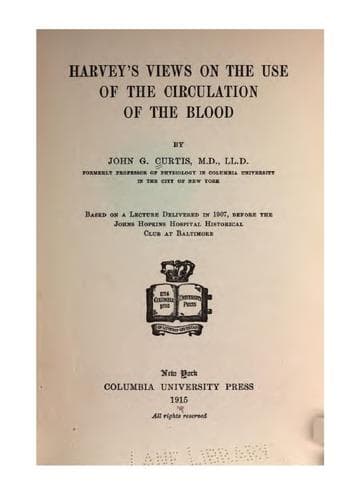
Harvey's Views on the Use of the Circulation of the BloodCurtis, John Green
History
Harvey's Views on the Use of the Circulation of the Blood
Curtis, John Green
Blood -- Circulation; Harvey, William, 1578-1657
"Not only does a liquid become thick which is made of water and
earthy matter, but also one made of water and spirits; even as
foam thickens and whitens; and the smaller and less conspicuous
the bubbles are, the whiter and stiffer does the mass appear.
Oil, too, is affected in the same way; for it becomes thick when
mixed with spirits, so that, as it whitens, it thickens; what
is watery within it being separated by the heat, and becoming
spirits.... For the reasons aforesaid the semen, too, is stiff
and white as it issues from within, since it contains much hot
spirits due to the interior heat. But after the exit of the
semen, when its heat has exhaled and its air has cooled, it
liquefies and darkens. For in drying semen, as in phlegm, the
water remains and perhaps some little earthy matter. The semen
then is a combination of spirits and water, the spirits being
hot air; so the semen, being derived from water, is naturally
liquid.... The cause of the whiteness of the semen is that the
generative medium (ἡ γονή) is foam, and that foam is
white.... It seems not to have escaped even the ancients that
the nature of semen is foamy; at all events they named from this
property (δυνάμεως) the goddess who rules coition."
(Aristotle: On the Generation of Animals, 735_b_, 8-16; 735_b_,
32 to 736_a_, 2; 736_a_, 13-14 and _a_, 18-21.)
A very ancient poem, ascribed to Hesiod, relates the myth of
Aphrodite and says that she was so called by gods and men "because
she was produced in foam." (Theogony, l. 197-198.) The "air"
ἀήρ o f one of the foregoing passages from Aristotle
is of course not atmospheric air, but something aëriform produced
by heat, as the context shows. In the same treatise he speaks of
the presence, within the early embryo which has never breathed,
of spirits (πνεῦμα) due to heat and moisture, "the one
active, the other passive." (On the Generation of Animals, 741_b_,
37 to 742_a_, 16.)
[321] The Latin translation quoted by Harvey renders the Greek words
"ὀυδὲ φαίνεται συνιστάμενον πυρουμένοις ὀύτ' [ἐν]
ὑγροῖς ὀύτ ἐν ξηροῖς ὀυθέν" (737a, 1-3) by the misleading
words "_neque constitui quidquam densis vel humidis vel siccis
videntur_." Therefore, in translating this passage into English, it
has seemed necessary to make it intelligible by giving to the word
"πυρουμένοις" its proper meaning, rather than by rendering
literally the earlier translator's ill-chosen Latin word "_densis_."
[322] The Latin quoted by Harvey, viz.: "_qui semine continetur_,"
scarcely gives the force of the original Greek "ἡ διὰ τοῦ
σπέρματος" (737_a_, 3-4), which Greek words, rather than the
Latin, are rendered in the present English translation.
Public-domain text, read in full here on John Shaqi.
Reviews
Reviews
No reviews yet
Be the first to share your thoughts on this work.
Elsewhere in the archive
Join the Discussion
Join the discussion
Sign in to leave a comment or review.
Sign InorCreate an account