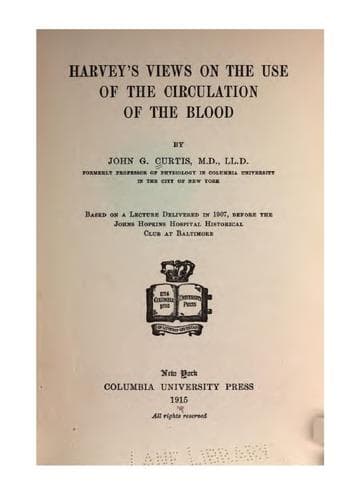
Harvey's Views on the Use of the Circulation of the BloodCurtis, John Green
History
Harvey's Views on the Use of the Circulation of the Blood
Curtis, John Green
Blood -- Circulation; Harvey, William, 1578-1657
"In the meantime I would propose this question to the learned:
How comes it that the fœtus continues in its mother's womb
after the seventh month? If brought forth at that time it
breathes at will, indeed could not survive one little hour
without breathing; yet, as I have said, if it remain in the womb
it keeps alive and well beyond the ninth month without the aid
of respiration.... Whoso shall attend carefully to these things
and consider more closely the nature of air, will, I think,
readily grant that air is given to animals neither for cooling
nor as nutriment; for it is a fact that after the fœtus has
once drawn breath it may be suffocated more quickly than when
entirely excluded from the air; as though heat were unkindled by
air within the fœtus rather than allayed. Thus much, merely
by the way, on the subject of respiration; perhaps I shall treat
of it more fully in its proper place. Surely a more knotty
subject could hardly be found, as the arguments on both sides
are very evenly balanced."[102]
So we find Harvey in his old age induced by lifelong study to
question, if not deny, even the cooling effects of respiration,
and to end with a practical confession of ignorance. Instead,
therefore, of the circulation and its swiftness being explained by
the urgent need of "the substance of the air" experienced by certain
tissues, that movement of the whole mass of the blood through the
lungs, which was so novel a physiological fact, does not seem to
have affected his view of the problems of respiration. Nor could he
properly explain the respiratory change in the color of the blood,
which seemed to support the ancient doctrine that the blood is
of two different kinds. Since he could not invoke respiration to
elucidate the circulation and its rapidity, and since he himself
declared that such rapidity could not be needed for the simple
feeding of the tissues, what was left to be invoked? It is no wonder
that eight years[103] after the publication of his discovery Harvey
denied that he had ever seriously undertaken to explain the use of
the circulation; that at the end of thirteen years more he repeated
this denial in his old age;[104] although he had not refrained from
expressing such conjectures as must always be evoked in the mind
of a great observer by a discovery of the first importance made by
himself. Yet the phenomena of the very circulation used were so
striking as to cry aloud for elucidation; for Harvey's own clinching
statement that the heart drives into the aorta at least one thousand
drachms of blood in half an hour,[105] this _reductio ad absurdum_,
which cut the ground from under the feet of his opponents, left him
helpless in his turn to account for the need of so huge a flooding
of the arteries.
Since it was not to be swiftly altered in the lungs that the whole
mass of the blood hurried back from all parts of the chest, what
then?
Public-domain text, read in full here on John Shaqi.
Reviews
Reviews
No reviews yet
Be the first to share your thoughts on this work.
Join the Discussion
Join the discussion
Sign in to leave a comment or review.
Sign InorCreate an account