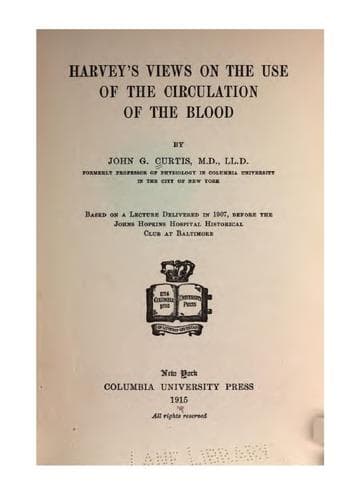
Harvey's Views on the Use of the Circulation of the BloodCurtis, John Green
History
Harvey's Views on the Use of the Circulation of the Blood
Curtis, John Green
Blood -- Circulation; Harvey, William, 1578-1657
It is a happy moment for a physiologist when the train which is
bearing him across the luxuriant plain of Venetia stops at the cry
of "Padova!" If he have not informed himself too thoroughly about
the sights which he will see at the Paduan University, he will enjoy
his own surprise when he is ushered into the Anatomical Theater of
Fabricius ab Aquapendente--a room in which standing-places rise
steeply, tier above tier, entirely around a small central oval pit.
Looking down into this, as he leans upon the rail, the traveler
will realize with sudden pleasure that William Harvey, when a
medical student, may often have leaned upon the self-same rail to
see Fabricius demonstrate the anatomy of man. The place looks fit
to have been a nursery of object-teachers, for it is too small
to hold a pompous _cathedra_; and the veteran to whose Latin the
young Englishman listened must have stood directly beside the dead
body. To an American, musing there alone, the closing years of the
sixteenth century, the last years of Queen Elizabeth of England,
which seem so remote to him when at home, are but as yesterday.
Recent, indeed, in the history of medicine is the year 1602, when
Harvey received his doctor's degree at Padua and returned to London;
but for all that we are right in feeling that our day is far removed
from his. The tireless progress of modern times has swept on at
the charging pace; but in Harvey's time books were still a living
force which had been written in days five and six times as far
removed from the student of Padua as he from us. Galen, the Greek
who practised medicine at imperial Rome in the second century of the
Christian era; Aristotle, who had been the tutor of Alexander the
Great five hundred years before Galen, when Rome was but a petty
state warring with her Italian neighbors;--these ancients were still
great working authorities in Harvey's day.[1]
It is against this persistent glow of the Greek thought that
Harvey stands out so vividly as the first great modern figure in
physiology. But it rather heightens than lowers his achievement that
it was by the ancient glow that he saw his way forward, admiring the
past, but not dazzled by it. In his old age he bade a young student
"goe to the fountain head and read Aristotle, Cicero, Avicenna";
and in talk with the same youth Harvey called the moderns by a name
so roughly contemptuous that it will not bear repeating.[2] Yet in
his old age, in the very act of extolling the ancients, he wrote as
follows:[3]--
"But while we acquiesce in their discoveries, and believe, such
is our sloth, that nothing further can be found out, the lively
acuteness of our genius languishes and we put out the torch
which they have handed on to us."
[Illustration: The Anatomical Theatre at Padua, where William Harvey
listened to the lectures of Fabricius ab Aquapendente.]
Public-domain text, read in full here on John Shaqi.
Reviews
Reviews
No reviews yet
Be the first to share your thoughts on this work.
Join the Discussion
Join the discussion
Sign in to leave a comment or review.
Sign InorCreate an account