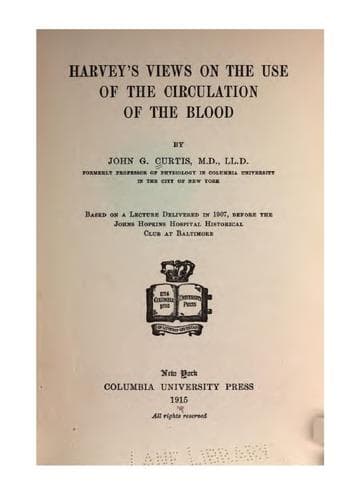
Harvey's Views on the Use of the Circulation of the BloodCurtis, John Green
History
Harvey's Views on the Use of the Circulation of the Blood
Curtis, John Green
Blood -- Circulation; Harvey, William, 1578-1657
"on the formation of the fœtus, where numerous problems of
the following order can find a place: Why should this part be
made or perfected earlier, that later? As regards the dominance
of the members: Which part is the cause of the other? There are
very many problems connected with the heart, such as: Why should
it be the first thing (as Aristotle says in his third book On
the Parts of Animals)[127] to acquire consistency, and be seen
possessed of life, motion, and sensation, before anything has
been perfected in the rest of the body? And in like manner
regarding the blood: Why is it before all, and how possessed
of the beginnings[128] of life and of the animal, and of the
craving to move and be impelled hither and thither, to which end
the heart would seem to have been made?"[129]
That Harvey should have printed this passage in 1628, in the same
work with his repeated eulogies of the Aristotelian heart, shows
that the idea of the possible primacy of the blood must have been
in his mind early. It was, indeed, so from the jotting down of
his private notes of 1616, to the publication of the Exercises to
Riolanus in 1649 and the treatise On Generation in 1651. The same
mental attitude is revealed, perhaps more strongly, in the following
passage of an earlier chapter of Harvey's treatise of 1628. Here
we come upon the thought that it may be the blood, and neither
ventricle nor auricle, which is the last to die. Harvey says:--
"Besides this, however, I have occasionally observed, after
the heart and even its right auricle[197] had ceased their
pulsations as though in the act of dying, that an obscure
motion and flow and a sort of palpitation manifestly remained
in the blood itself contained in the right auricle, so long,
that is, as the blood appeared to be imbued with heat and
spirits. Something of the sort is very plainly to be seen at
the beginning of the generation of an animal, in the hen's egg
within the first seven days of incubation. There is present,
first and before all else, a drop of blood which palpitates (as
Aristotle also noted); from which, when growth has taken place
and the chick has been formed to some extent, the auricles of
the heart are made; and in these, which pulsate perpetually,
life inheres....
"Whoever, therefore, shall choose to investigate more closely
will say that the heart is not the first to live and the last to
die, but that the auricles, and the part which answers thereto
in serpents, fishes, and such animals, are alive sooner than the
heart itself and also die later than the heart. Whether even
earlier the blood itself, or the spirit, have not an obscure
palpitation of its own, which it has seemed to me to retain
after death, may well be questioned; and whether we should not
speak of life as beginning with palpitation."[198]
Public-domain text, read in full here on John Shaqi.
Reviews
Reviews
No reviews yet
Be the first to share your thoughts on this work.
Elsewhere in the archive
Join the Discussion
Join the discussion
Sign in to leave a comment or review.
Sign InorCreate an account