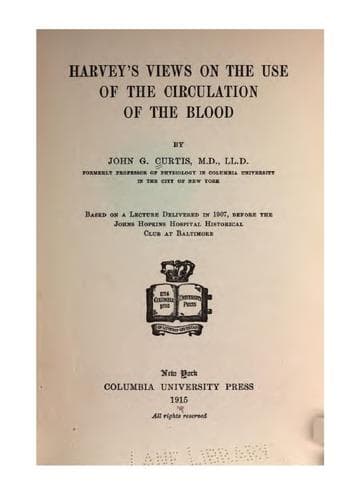
Harvey's Views on the Use of the Circulation of the BloodCurtis, John Green
History
Harvey's Views on the Use of the Circulation of the Blood
Curtis, John Green
Blood -- Circulation; Harvey, William, 1578-1657
"This is a way from the heart, that to the heart; that contains
cruder blood, effete and rendered unfit for nutrition; this,
concocted, perfect, alimentary blood."[9]
Harvey, indeed, as we shall find abundant evidence, was both an
observer and a speculator. In the latter rôle he was not far removed
from his physiological predecessors of two thousand years; as an
observer it was his great merit to lead the physiologists of his
time and to point out to those of all later centuries the path which
they must follow.
CHAPTER II
THE CIRCULATION AND THE FEEDING OF THE TISSUES
That Harvey frequently took refuge in speculation need excite no
surprise. In the seventeenth century, even with his extraordinary
contributions of observed fact to the knowledge of the circulation
of the blood, the paucity of physiological knowledge in general and
of experimental methods was so great that at every turn a thinking
man was tempted to fill in the gaps with that which was beyond his
powers of ocular demonstration. Contemplation of the circulation,
indeed, led Harvey into contemplation of widely diverse problems of
the life process. The feeding of the tissues, the significance of
respiration, the cause of the heart-beat, the relative importance of
the heart and the blood in the bodily hierarchy, the bodily heat and
its source, and the seat of the soul--to these and other topics he
gave much attention, and these we must consider. Let us begin with
the circulation and its relation to the feeding of the tissues.
In the chapter of Harvey's book which follows at once upon the brief
qualitative statement quoted at the end of our last chapter, Harvey
himself brings us face to face with the difficult quantitative
question raised by his triumphant proof of the circulation. He
says:--
"The blood under the influence of the arterial pulse enters and
is impelled in a continuous, equable, and incessant stream into
every part and member of the body, in much larger quantity than
were sufficient for nutrition or than the whole mass of fluids
could supply."[10]
Public-domain text, read in full here on John Shaqi.
Reviews
Reviews
No reviews yet
Be the first to share your thoughts on this work.
Join the Discussion
Join the discussion
Sign in to leave a comment or review.
Sign InorCreate an account