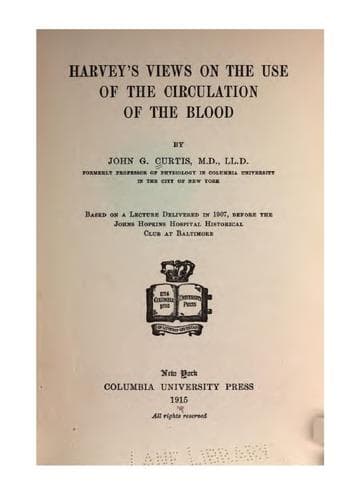
Harvey's Views on the Use of the Circulation of the BloodCurtis, John Green
History
Harvey's Views on the Use of the Circulation of the Blood
Curtis, John Green
Blood -- Circulation; Harvey, William, 1578-1657
More than thirty-two years earlier Harvey had written in his
note-book the following words:--
"N.B. The lungs by their movement in subsiding propel blood from
the arterial vein into the venous artery and thence into the
left auricle."[270]
When we review and ponder the foregoing delineations of the
character of the movement of the blood, we may cease to wonder
that Harvey did not recognize the simple hydraulic cause of the
distention of the right auricle and felt obliged to seek a more
recondite explanation thereof, finding this in an Aristotelian
expansion of the hot blood.
CHAPTER IX
THE BLOOD THE SEAT OF THE SOUL
No doctrine of Harvey sounds stranger to a biologist of to-day than
his doctrine that the blood is the seat of the soul; nor does any
other belief of the great discoverer reveal him more clearly to be a
link between the old and the new; not simply an innovator who fixed
a gulf between them. We have heard him explicitly deny in his old
age the Aristotelian doctrine that the heart "is endowed with soul."
We have seen that thirty-five years earlier he had jotted down in
his note-book these words: "The soul is in the blood."[271] Let us
study him now as he lays stress, not merely on the primacy of the
blood, but on its psychological endowments.
Thirteen years before the date of Harvey's note-book Shakspere's
play of "Hamlet" had appeared in print; in which the prince speaks
thus of following his father's ghost:--
"Why, what should be the fear?
I do not set my life at a pin's fee;
And, for my soul, what can it do to that,
Being a thing immortal as itself?"[272]
It has been foreshadowed that for Harvey, the graduate of
Cambridge and of Padua, the physician of the Renaissance, the word
"_anima_"--"soul"--did not simply mean the immortal part of man,
as for Hamlet, but was equivalent to the "_psyche_" of ancient
philosophy. In order, therefore, readily to follow Harvey's thought
at this juncture, we must first, like him, go to the fountain head;
for only sayings of Aristotle can give us a sufficient clue to what
he, and after him Harvey, meant by "soul."
Aristotle says in his treatise On Soul:--
"Some natural bodies have life and some have not. By life we
mean the being nourished, and growing, and decaying, of oneself."
In the same treatise he says further:--
"The soul is that by which primarily we are alive, and
display sensation and intellect; ... but it is not matter and
substratum."
Again he says:--
"Were the eye an animal, vision would be the soul thereof; for
reason indicates that vision is the essence of the eye.[273] The
eye in its turn is the material [basis] of vision; which latter
failing, the eye is not an eye except in name, like an eye of
stone or in a drawing."
The doctrines of the foregoing three passages are developed and made
more explicit in the following, still from the treatise On Soul:--
Public-domain text, read in full here on John Shaqi.
Reviews
Reviews
No reviews yet
Be the first to share your thoughts on this work.
Elsewhere in the archive
Join the Discussion
Join the discussion
Sign in to leave a comment or review.
Sign InorCreate an account