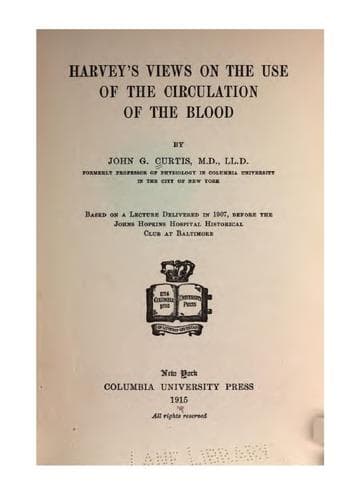
Harvey's Views on the Use of the Circulation of the BloodCurtis, John Green
History
Harvey's Views on the Use of the Circulation of the Blood
Curtis, John Green
Blood -- Circulation; Harvey, William, 1578-1657
"It is the presence of life, we say, which makes the difference
between that which has soul and that which has not. To amplify
regarding life: we call anything alive which possesses even a
single one of the following: intellect, sensation, motion and
rest in space, and also the motion[274] involved in nutrition,
and both decay and growth. Therefore, even all the plants are
held to be alive."
A few lines further on Aristotle says, speaking of the power or
faculty[275] of taking nourishment:--
"This can exist without the others, but not the other faculties
without this, in mortal beings. The aforesaid is clear in the
case of plants; for they possess no other faculty of the soul.
To this faculty then life owes its origin in living things; but
the being an animal owes its origin primarily to sensation;
for beings that neither move nor change their place but yet
possess sensation, we call animals and not merely living things.
The primary sense, which exists in all, is touch; and just as
the nutritive faculty can exist without touch or sensation of
any kind, so can touch exist without the other senses. The
"nutritive" is our term for such part of the soul as is shared
even by plants, all animals, however, evidently possessing the
sense of touch. The cause of the presence of each of the two
aforesaid shall be told later. Now let us only go so far as to
say that the soul is the source of the [faculties] aforesaid,
and is defined by means of them, to wit: the nutritive, the
sensory, the intellectual, the motor.[276] As to whether each of
these is a soul or is a part of the soul; and if a part, whether
in the sense that it is only separable by reasoning,[277] or
locally as well--as to some of these points, it is not hard to
see our way, but some present difficulties."[278]
If we turn to Aristotle's treatise On Generation we find him dealing
with the relations of the body to the nutritive soul, in virtue
whereof the body is alive; with its relations to the sensory soul,
in virtue whereof it is an animal body; and, finally, in man with
its relations to the intellectual soul. Of these three kinds of
soul or parts of the soul, he concludes, the mind "is alone divine;
for in the working thereof no bodily working is involved."[279]
Only soul of this divine quality does he admit to be separable from
body.[280]
The master has spoken. Now let the great pupil speak. In the last
Exercise but one of his treatise On Generation, Harvey says,
referring to the blood:--
Public-domain text, read in full here on John Shaqi.
Reviews
Reviews
No reviews yet
Be the first to share your thoughts on this work.
Elsewhere in the archive
Join the Discussion
Join the discussion
Sign in to leave a comment or review.
Sign InorCreate an account