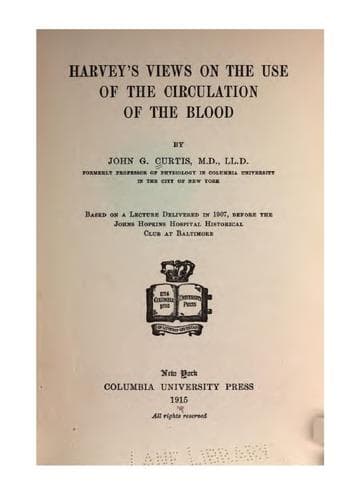
Harvey's Views on the Use of the Circulation of the BloodCurtis, John Green
History
Harvey's Views on the Use of the Circulation of the Blood
Curtis, John Green
Blood -- Circulation; Harvey, William, 1578-1657
Presently Harvey himself shall tell us that in placing the soul in
the blood he is consciously reaffirming one of the most ancient of
beliefs; but he is far from basing his adhesion to it merely on such
immemorial evidence, known to all, as the result of loss of blood,
for he also adduces once more his own observations of the early
embryo of the fowl, to prove not only the primacy of the blood but
the presence of the soul therein. His testimony follows, and in
reading it one must bear carefully in mind that in Harvey's time
no clear scientific distinction had yet been worked out between
movements which imply sensation, and movements, whether reflex or
not, which do not depend upon consciousness. In his treatise On
Generation Harvey says:--
"For my own part I am sure from numerous experiments that not
only motion is inherent in the leaping point,--which no one
denies--but sensation also. For you will see this point thrown
into varied commotion and, as it were, irritated, at any touch
whatever, even the slightest, just as sensitive bodies in
general usually give evidence of sensation by movements proper
to themselves. Moreover, if the injury be repeated often, the
leaping point becomes excited and the rhythm and order of its
pulsations disturbed. In like manner do we infer the presence
of sensation in the so-called sensitive plant and in zoöphytes,
from the fact that when they are touched they draw themselves
together as though taking it ill.... So there is no doubt that
the leaping point lives, moves, and feels like an animal."[285]
In a later part of the same treatise he says:--
"It is manifest that all motion and sensation do not proceed
from the brain, since we plainly perceive the presence of motion
and sensation before the brain has come into existence; what
I have related proves that clearly sensation and motion dawn
forthwith in the first droplet of blood in the egg, before a
vestige of the body has been formed. Moreover, in that first
state of the structure or constitution of the body which I have
called the mucilaginous, before any members are discernible and
when the brain is nothing but limpid water, if the body be only
lightly pricked it moves, contracts, and twists itself obscurely
like a worm or caterpillar; so that it gives clear evidence of
sensation."[286]
In another Exercise of the same treatise he says:--
Public-domain text, read in full here on John Shaqi.
Reviews
Reviews
No reviews yet
Be the first to share your thoughts on this work.
Elsewhere in the archive
Join the Discussion
Join the discussion
Sign in to leave a comment or review.
Sign InorCreate an account