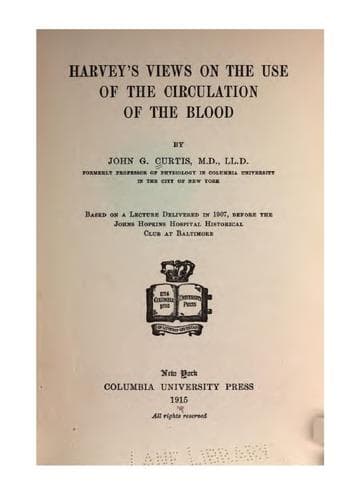
Harvey's Views on the Use of the Circulation of the BloodCurtis, John Green
History
Harvey's Views on the Use of the Circulation of the Blood
Curtis, John Green
Blood -- Circulation; Harvey, William, 1578-1657
These are more numerous than the
seven planets; for though each planet is set in but a single sphere,
each planet's complex course results from the combined simple
motions of more spheres than one. In spite of these more or less
intimate relations, the spheres of heaven are separate existences,
self-moved, like animals; and, like animals, possess activity, life,
and soul. But the motion and life of the heavenly existences are
continuous and eternal, and hence these existences--the spheres,
and the planets and fixed stars set therein--are all divine; much
more divine than man, though man possesses a far larger share of the
divine than other animals.[328]
Just as the troubled regions which lie below the sphere of the moon
are contrasted with the serene heaven which incloses and limits
them, so the changing forms of matter which compose our globe and
its nearer surroundings are contrasted with the simple unalterable
substance of the heavenly spheres. "Of necessity," says Aristotle,
"there exists a simple body whose very nature it is to be borne
on in circular motion."[329] Elsewhere he says that the men of old
"would seem to have assumed that the body which moves forever is
likewise divine by nature."[330] This is "an embodied substance
different from the compounds here, more divine and prior to them
all";[331] a body "of a nature the more precious the farther it is
withdrawn from what is here."[332] After reasoning about this body
Aristotle says:--
"If what has been laid down be accepted, it is plain from the
foregoing why the first of bodies is eternal, and shows neither
growth nor decay nor old age nor alteration, and is affected by
nothing. The conception seems to testify to the phenomena and
the phenomena to the conception.... Therefore, as the first body
is something different from earth and fire and air and water,
[the ancients] gave the name of ether to the region most on
high, naming it from its moving always during all eternity."[333]
The place in nature of "the first element," so grandly conceived,
is fixed more definitely by Aristotle when he says "that the whole
universe in the region of the courses on high is filled with that
body."[334]
Now, therefore, we have attained the object of our rapid quest;
at last we have reached "the element of the stars"; for Aristotle
tells us that not only heaven, but all the heavenly bodies as well,
consist of the ether, saying:--
"It is most reasonable and consequent, in view of things already
said, for us to make each of the stars out of that body in which
it has its course, since we have declared the existence of
something of which the nature is to be borne in a circle."[335]
Public-domain text, read in full here on John Shaqi.
Reviews
Reviews
No reviews yet
Be the first to share your thoughts on this work.
Elsewhere in the archive
Join the Discussion
Join the discussion
Sign in to leave a comment or review.
Sign InorCreate an account