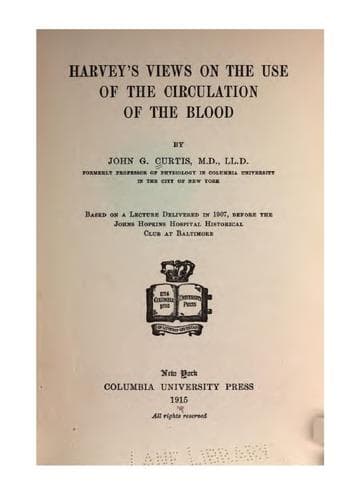
Harvey's Views on the Use of the Circulation of the BloodCurtis, John Green
History
Harvey's Views on the Use of the Circulation of the Blood
Curtis, John Green
Blood -- Circulation; Harvey, William, 1578-1657
On reaching the end of the last quoted words of Harvey's polemic,
a physician or biologist of to-day may easily be conscious of
disappointment, even of a mild despair; for the once celebrated
passage from Aristotle, about the interpretation of which Harvey
gives battle, seems at first the source of all the obscurities of
the controversy, rather than of the promised light which shall clear
them away. Yet that light must come by way of that rugged passage.
The gist of the first part of the Aristotelian passage may be set
forth as follows: In the semen soul is potential, being associated
therein with a "body" or "nature" which possesses a "life-giving
principle" and is in the spirits, _i.e._, in the hot vapor, within
the foam-bubbles of the semen. This body or nature is called heat,
yet it is not that one of the four elemental bodies which is known
as fire, nor yet a derivative of this, but is "a body other than
the so-called elements and more divine," a "nature analogous to
the element of the stars." What is this "element of the stars"?
It is clear that only from the answer to this question can the
light which we are seeking begin to shine. To find this celestial
element we must immediately take a rapid glance at the Aristotelian
universe--that grand conception which the master mainly accepted
from his predecessors and contemporaries, but owed, in part, to
the work of his own mind. Let us swiftly scan what he styled the
"Cosmos."
At the center thereof is the earth, spherical and motionless. The
core of the universe consists not only of this central globe with
everything in or upon it, but also of the atmosphere or, more
correctly, of all which extends between the surface of the globe
and the nearest of the distant revolving hollow spheres of heaven,
in some of which spheres are set the heavenly bodies. Below the
heavenly spheres this core of the universe is made up of the four
elements, earth, water, air, and fire; and all things composed of
these are subject to opposed and limited and compounded motions, to
generation, alteration, and corruption. The inclosing heaven, on the
other hand, is unchangeable and eternal, has never been created,
and will never be destroyed. Its many component hollow spheres are
contiguous and concentric, and concentric also with our globe.
In a single sphere, the outermost, called the "first heaven,"
all the fixed stars are set. In separate spheres, nearer to the
earth, are set the seven bodies which the astronomy of Aristotle's
day styled "planets." To these (here designated by their present
names) that ancient astronomy assigned the following order from the
earth outward toward the fixed stars: the moon, the sun, Venus,
Mercury, Mars, Jupiter, and Saturn. Each of the celestial spheres
revolves with simple circular motion in one direction forever. The
"first heaven," the sphere of the fixed stars, needs but the one
simple motion which is its own, and it carries with it in its daily
revolution all the inner spheres.
Public-domain text, read in full here on John Shaqi.
Reviews
Reviews
No reviews yet
Be the first to share your thoughts on this work.
Elsewhere in the archive
Join the Discussion
Join the discussion
Sign in to leave a comment or review.
Sign InorCreate an account