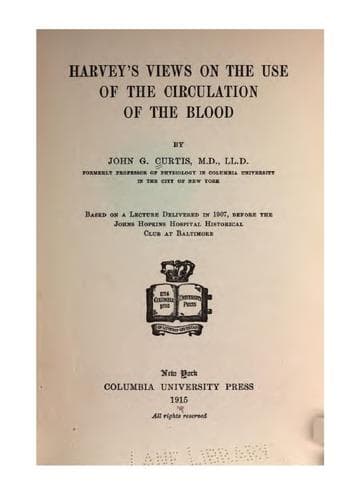
Harvey's Views on the Use of the Circulation of the BloodCurtis, John Green
History
Harvey's Views on the Use of the Circulation of the Blood
Curtis, John Green
Blood -- Circulation; Harvey, William, 1578-1657
"All natural bodies present themselves in a double relation, to
wit: according as they are reckoned with apart and comprehended
within the circuit of their own proper nature, or according as
they are the instruments of some nobler and superior authority.
For, as to their own proper powers, there is no doubt that all
things which are subject to generation and corruption derive
their origin from the elements, and work according to the
standard thereof. In so far, however, as all things so subject
are instruments of a more excellent agent and are regulated
thereby, their works do not proceed from their own proper nature
but from the rule of that other; and, consequently, they seem to
be associated with another and more divine body and to exceed
the powers of the elements."[354]
In the very next Exercise, however, that On the Primitive Moisture,
the last Exercise of Harvey's treatise On Generation, we come
suddenly upon a reason why "the powers of the elements" must have
seemed to him something to be treated rather as a convenient
form of words than as a serious doctrine, despite his respectful
argument just quoted. Speaking of the "primitive moisture," the
great observer says that he sees in the hen's egg that out of
that "crystalline colliquament," that "simplest body" alone,
all the parts of the embryo are made and increased;[355] and
proceeds bluntly to question the reality of the elements, "namely,
the fire, air, water, and earth of Empedocles and Aristotle; or
the salt, sulphur, and mercury of the chemists; or the atoms of
Democritus."[356] Harvey says:--
"Therefore, the so-called elements do not exist prior to
whatever is generated or arises; but rather are subsequent
thereto, being remains rather than origins. Not even Aristotle
himself, nor any one else, has ever demonstrated that elements
exist separately in nature, or give rise to bodies which consist
of parts similar one to another."[357]
Almost immediately after this tug at the foundations of the
Aristotelian universe, Harvey brings his treatise On Generation to
an end.
Public-domain text, read in full here on John Shaqi.
Reviews
Reviews
No reviews yet
Be the first to share your thoughts on this work.
Elsewhere in the archive
Join the Discussion
Join the discussion
Sign in to leave a comment or review.
Sign InorCreate an account