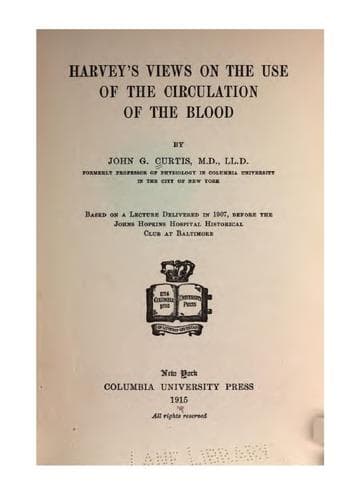
Harvey's Views on the Use of the Circulation of the BloodCurtis, John Green
History
Harvey's Views on the Use of the Circulation of the Blood
Curtis, John Green
Blood -- Circulation; Harvey, William, 1578-1657
The admirable feature of Harvey's brief last-published discussion
of the circulating blood is this, that the aged veteran ever
strikes vigorous blows for observation, for the use of the senses,
in the search for truth. But we have seen already that by his arm,
as by another's, the blows are delivered both for better and for
worse. Rightly does he drive out of court the spirits "ethereal
and elemental" which no man can demonstrate. Wrongly does he
discredit the real complexity of that humor, to the eye so simple
and crystal-clear, out of which he believes all the diverse parts of
the living bird to be developed. In Harvey's present polemic we find
no new appeal to nature; he vindicates the justice of his former
appeals and maintains with vigor the doctrines already familiar to
us, that the blood is the principal part of the body, is itself the
innate heat, and is the seat of the soul. This relation of blood
and soul he reaffirms very impressively in this, his final public
utterance; a most important passage of which, about the presence
of the soul in the blood, has been embodied in the chapter on that
subject of the present paper.[358]
But evidently the main purpose of his polemical Exercise on the
Innate Heat is to cast out of the blood the futile spirits which
obscure the real relation of that heat to the circulating blood; and
so to defend the thesis best set forth in the following words of his
own:--
"In truth, the blood alone is the innate warmth, or the first
born psychical heat; as is proved excellently well by our
observations of the generation of animals, especially of the
chick in the egg; so that it were superfluous to multiply
entities....[359] What need, then, is there, say I, of that
foreign guest, ethereal heat, since all can be accomplished by
the blood, even as by it?"[360]
Harvey has expelled from the blood the mythical spirits which had
stood in the way of the direct identification of the blood with
the innate heat. But how does he interpret the famous words of
Aristotle which he quotes, and declares not to have been "rightly
interpreted" by the champions of ethereal spirits? When we seek an
answer to this question, we do not find the veteran discoverer at
his best. The ancient philosopher surely would have been as much
surprised at Harvey's interpretation of his words as at any use of
them made by Scaliger or Fernelius. We have seen that Harvey follows
up his quotation from Aristotle by promptly applying its language,
literally or by paraphrase, to the innate heat and the blood.[361]
Emphatic are the words which immediately follow the words of
Aristotle. Harvey says:--
"I, too, would say the same, for my part, of the innate heat and
the blood, to wit: that it is not fire and does not take its
origin from fire, but is associated with another body and that
more divine."
Public-domain text, read in full here on John Shaqi.
Reviews
Reviews
No reviews yet
Be the first to share your thoughts on this work.
Elsewhere in the archive
Join the Discussion
Join the discussion
Sign in to leave a comment or review.
Sign InorCreate an account