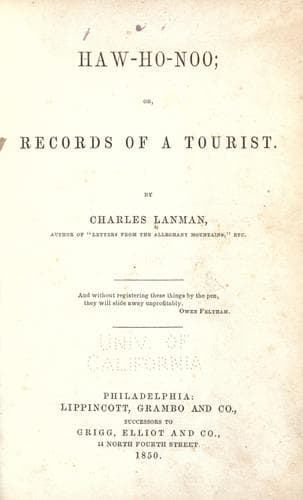
Haw-Ho-Noo; Or, Records of a TouristLanman, Charles
History
Haw-Ho-Noo; Or, Records of a Tourist
Lanman, Charles
Fishing -- North America; United States -- Description and travel
On the left is the Temple of Mammon, a superb and costly structure,
surmounted by the wheel of Fortune. Beneath its dome, a
curiously-wrought fountain throws out showers of gold, which is eagerly
caught up by the votaries below.
From the great censers, rising here and there above the heads of the
multitude, clouds of incense roll up and wreath the columns of the
temple—a grateful odor to the God. The trees and shrubbery of the
adjacent grounds are laden with golden fruit.
Far distant, in the middle of the picture, a vision of earthly power and
glory rises upon the view. Splendid trophies of conquest adorn the
imposing gateway; suits of armor, gorgeous banners, and the victor’s
wreath. Colonnades and piles of architecture stretch away in the vast
perspective. At the summit of a lofty flight of steps stand conspicuous
the throne and the sceptre. Suspended in the air, at the highest point
of human reach, is that glittering symbol of royalty, the crown. Between
the beholder and this grand spectacle are the armies in conflict, and a
city in flames, indicating that the path to glory lies through ruin and
the battle-field. To the contemplation of this alluring scene the
Pilgrim of the World, now in the morning of manhood, is introduced.
Which of the fascinating objects before him is the one of his choice, is
left to the imagination of the spectator. The picture symbolizes the
pleasure, the fortune, and the glory of the world.
In the fourth picture, the pilgrim, now an old man on the verge of
existence, catches a first view of the boundless and eternal. The
tempests of life are behind him; the world is beneath his feet. Its
rocky pinnacles, just rising through the gloom, reach not up into his
brightness; its sudden mists, pausing in the dark obscurity, ascend no
more into his serene atmosphere. He looks out upon the infinite.
Clouds—embodiments of glory, threading immensity in countless lines,
rolling up from everlasting depths—carry the vision forward toward the
unapproachable light. The Cross, now fully revealed, pours its
effulgence over the illimitable scene. Angels from the presence, with
palm and crown of immortality, appear in the distance, and advance to
meet him. Lost in rapture at the sight, the pilgrim drops his staff, and
with uplifted hands, sinks upon his knees.
In the last picture, desolate and broken, the pilgrim, descending a
gloomy vale, pauses at last on the horrid brink that overhangs the outer
darkness. Columns of the Temple of Mammon crumble; trees of the gardens
of pleasure moulder on his path. Gold is as valueless as the dust with
which it mingles. The phantom of glory—a baseless, hollow fabric—flits
under the wing of death to vanish in a dark eternity. Demon forms are
gathering around him. Horror-struck, the pilgrim lets fall his staff,
and turns in despair to the long-neglected and forgotten Cross. Veiled
in melancholy night, behind a peak of the mountain, it is lost to his
view forever.
Public-domain text, read in full here on John Shaqi.
Reviews
Reviews
No reviews yet
Be the first to share your thoughts on this work.
Elsewhere in the archive
Join the Discussion
Join the discussion
Sign in to leave a comment or review.
Sign InorCreate an account