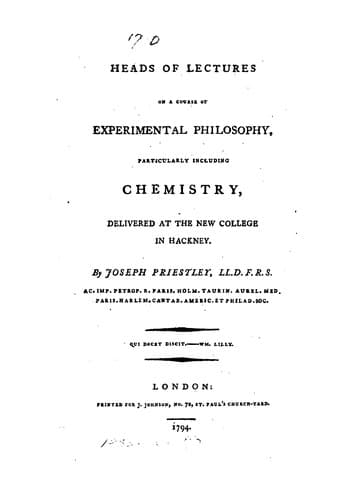
Heads of Lectures on a Course of Experimental Philosophy: Particularly Including ChemistryPriestley, Joseph
Philosophy
Heads of Lectures on a Course of Experimental Philosophy: Particularly Including Chemistry
Priestley, Joseph
Chemistry -- Early works to 1800
Copper is sometimes found native; but commonly mixed with sulphur, in
ores of a red, green, or blue colour.
Copper being an earlier discovery than that of iron, was formerly used
for weapons and the shoeing of horses; and the ancients had a method,
with which we are not well acquainted, of giving it a considerable
degree of hardness, so that a sword made of it might have a pretty good
edge.
LECTURE XXV.
_Of Iron._
Iron is a metal of a bluish colour, of the greatest hardness, the most
variable in its properties, and the most useful of all the metals; so
that without it it is hardly possible for any people to make great
advances in arts and civilization.
This metal readily parts with its phlogiston, so as to be very subject
to calcine, or rust, by exposure to the air. The same is evident by the
colours which appear on its surface when exposed to heat, and also when
it is struck with flint; the particles that fly from it being iron
partially calcined. In consequence of its readily parting with its
phlogiston, it is capable of burning, like wood or other fuel, in pure
air.
Iron and platina have the property of _welding_ when very hot, so that
two pieces may be joined without any solder.
When iron is heated in contact with steam, part of the water takes the
place of the phlogiston, while the rest unites with it, and makes
inflammable air. By this means the iron acquires one third more weight,
and becomes what is called _finery cinder_. This substance, heated in
inflammable air, imbibes it, parts with its water, and becomes perfect
iron again. If the iron be heated in pure air, it also imbibes the
water, of which that air chiefly consists, and also a portion of the
peculiar element of the pure air.
The solution of iron in spirit of vitriol produces _green copperas_;
which being calcined, becomes a red substance, called _colcothar_.
The precipitate of iron, by an infusion of galls, is the colouring
matter in _ink_, which is kept suspended by means of gum. The
precipitate from the same solution by phlogisticated alkali, is
_Prussian blue_.
Water saturated with fixed air dissolves iron, and makes a pleasant
chalybeat.
The calx of iron gives a green colour to glass.
Iron readily combines with sulphur. When they are found combined by
nature, the substance is called _pyrites_.
The union of phosphoric acid with iron makes it brittle when cold,
commonly called _cold short_; and the union of arsenic makes it brittle
when hot, thence called _red short_.
Iron unites with gold, silver, and platina, and plunged in a white heat
into mercury, it becomes coated with it; and if the process be
frequently repeated, it will become brittle, which shews that there is
some mutual action between them.
Iron readily unites with tin; and by dipping thin plates of iron into
melted tin, they get a complete coating of it, and make the _tinned
plates_ in common use.
Public-domain text, read in full here on John Shaqi.
Reviews
Reviews
No reviews yet
Be the first to share your thoughts on this work.
Join the Discussion
Join the discussion
Sign in to leave a comment or review.
Sign InorCreate an account