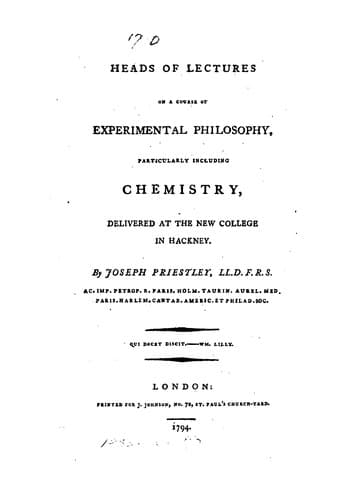
Heads of Lectures on a Course of Experimental Philosophy: Particularly Including ChemistryPriestley, Joseph
Philosophy
Heads of Lectures on a Course of Experimental Philosophy: Particularly Including Chemistry
Priestley, Joseph
Chemistry -- Early works to 1800
When crude iron comes from the smelting furnace it is brittle; and when
it is white within, it is extremely hard; but when it has a black grain,
owing to its having more phlogiston, it is softer, and may be filed and
bored.
Cast iron becomes _malleable_ by being exposed to a blast of air when
nearly melting; the consequence of which is a discharge of inflammable
air, and the separation of a liquid substance, which, when concreted, is
called _finery cinder_. The iron generally loses one fourth of its
weight in the process. Crude iron contains much _plumbago_, and the
access of pure air probably assists in discharging it, by converting it
into air, chiefly inflammable.
Malleable iron, exposed to a red heat in contact with charcoal, called
_cementation_, converts it into _steel_, which has the properties of
becoming much harder than iron, and very elastic, by being first made
very hot, and then suddenly cooled, by plunging it in cold water. By
first making it very hard, and then giving different degrees of heat,
and cooling it in those different degrees, it is capable of a great
variety of _tempers_, proper for different uses. Of the degrees of heat
workmen judge by the change of colour on its surface. Steel, like crude
iron, is capable of being melted without losing its properties. It is
then called _cast steel_, and is of a more uniform texture. Iron
acquires some little weight by being converted into steel; and when
dissolved in acid, it yields more plumbago. Steel has something less
specific gravity than iron. If the cementation be continued too long,
the steel acquires a darkish fracture, it is more fusible, and incapable
of welding. Steel heated in contact with earthy matters, is reduced to
iron.
Iron is the only substance capable of _magnetism_; and hardened steel
alone is capable of retaining magnetism. The loadstone is an ore of
iron.
LECTURE XXVI.
_Of Tin._
Tin is a metal of a slightly yellowish cast, though harder than lead,
very malleable, but of no great tenacity; so that wires cannot be made
of it. It easily extends under the hammer, and plates of it, called
_tinfoil_, are made only one thousandth part of an inch thick, and might
be made as thin again.
Tin has less specific gravity than any other metal. It melts long before
ignition, at 410 of Fahrenheit, and by the continuance of heat is slowly
converted into a white powder, which is the chief ingredient in _putty_,
used in polishing, &c. Like lead, it is brittle when heated little short
of fusion, and may be reduced into grains by agitation as it passes from
a fluid to a solid state.
The calx of tin resists fusion more than that of any other metal, which
makes it useful in making an opaque white enamel.
Tin loses its bright surface when exposed to the air, but is not
properly subject to rust; so that it is useful in protecting iron and
other metals from the effects of the atmosphere.
Public-domain text, read in full here on John Shaqi.
Reviews
Reviews
No reviews yet
Be the first to share your thoughts on this work.
Join the Discussion
Join the discussion
Sign in to leave a comment or review.
Sign InorCreate an account