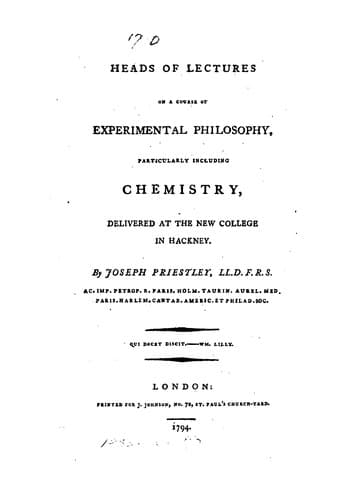
Heads of Lectures on a Course of Experimental Philosophy: Particularly Including ChemistryPriestley, Joseph
Philosophy
Heads of Lectures on a Course of Experimental Philosophy: Particularly Including Chemistry
Priestley, Joseph
Chemistry -- Early works to 1800
Concentrated vitriolic acid, assisted by heat, dissolves half its weight
of tin, and yields vitriolic acid air. With more water it yields
inflammable air. During the solution the phlogiston of the tin uniting
with the acid, forms sulphur, which makes it turbid. By long standing,
or the addition of water, the calx of tin is precipitated from the
solution. The nitrous acid dissolves tin very rapidly without heat, and
yields but little nitrous air. With marine acid this metal yields
inflammable air. With aqua regia it assumes the form of a gelatinous
substance used by dyers to heighten the colour of some red tinctures, so
as to produce a bright scarlet in dying wool.
A transparent liquor, which emits very copious fumes, called, from the
inventor, _the smoking liquor of Libavius_, is made by distilling equal
parts of amalgam of tin and mercury with corrosive sublimate, triturated
together. A colourless liquor comes over first, and then a thick white
fume, which condenses into the transparent liquor above mentioned. Mr.
Adet has shewn, that this liquor bears the same relation to the common
solution of tin, that corrosive sublimate does to calomel, and has given
an ingenious solution of many of its properties.
Tin detonates with nitre; and if the crystals made by the solution of
copper in the nitrous acid be inclosed in tinfoil, nitrous fumes will be
emitted, and the whole will become red hot. Also if five times its
weight of sulphur be added to melted tin, a black brittle compound,
which readily takes fire, will be formed.
Another combination of tin, sulphur, and mercury, makes a light yellow
substance called _aurum musivum_ used in painting.
Tin is the principal ingredient in the composition of _pewter_, the
other ingredients being lead, zinc, bismuth, and copper; each pewterer
having his peculiar receipt. It is also used in coating copper and iron
plates, and in silvering looking-glasses, besides being cast into a
variety of forms, when it is called _block tin_.
Tin is sometimes found native, but is generally mineralized with sulphur
and arsenic. The latter is thought to be always contained in tin, and to
be the cause of the crackling noise made by bending plates of it.
_Of the Semi-metals._
Bismuth is a semi-metal of a yellowish or reddish cast, but little
subject to change in the air; harder than lead, but easily broken, and
reducible to powder. When broken it exhibits large shining facets, in a
variety of positions. Thin pieces of it are considerably sonorous.
Bismuth melts at about 460 deg. of Fahrenheit. With more heat it ignites,
and burns with a slight blue flame, while a yellowish calx, called
_flowers of bismuth_, is produced. With more heat it becomes a greenish
glass. In a strong heat, and in close vessels, this metal sublimes.
Public-domain text, read in full here on John Shaqi.
Reviews
Reviews
No reviews yet
Be the first to share your thoughts on this work.
Join the Discussion
Join the discussion
Sign in to leave a comment or review.
Sign InorCreate an account