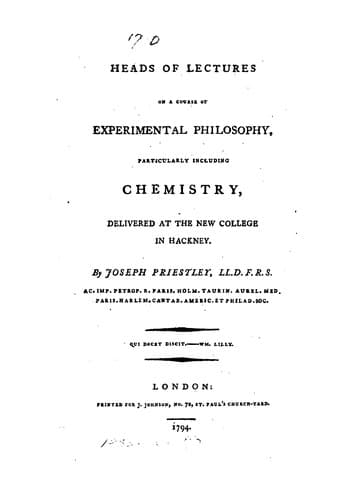
Heads of Lectures on a Course of Experimental Philosophy: Particularly Including ChemistryPriestley, Joseph
Philosophy
Heads of Lectures on a Course of Experimental Philosophy: Particularly Including Chemistry
Priestley, Joseph
Chemistry -- Early works to 1800
Vitriolic acid, even concentrated and boiling, has but little effect
upon bismuth; but the nitrous acid acts upon it with the greatest
rapidity and violence, producing much nitrous air, mixed with
phlogisticated nitrous vapour. From the solution of bismuth in this
acid, a white substance, called _magistery of bismuth_, is precipitated
by the affusion of water. This has been used as a paint for the skin
but has been thought to injure it.
The marine acid does not readily act upon bismuth; but when
concentrated, it forms with it a saline combination, which does not
easily crystallize, but may be sublimed in the form of a soft fusible
salt, called _butter of bismuth_.
Bismuth unites with most metallic substances, and in general renders
them more fusible. When calcined with the imperfect metals, it unites
with them, and has the same effect as lead in cupellation.
Bismuth is used in the composition of pewter, in printers' types, and
other metallic mixtures.
This metal is sometimes found native, but more commonly mineralized with
sulphur.
LECTURE XXVII.
_Of Nickel._
Nickel is a semi-metal of a reddish cast, of great hardness, and always
magnetical; on which account it is supposed to contain iron, though
chemists have not yet been able to separate them.
The purest nickel was so infusible as not to run into a mass in the
strongest heat of a smith's forge; but then it was in some degree
malleable.
Concentrated acid of vitriol only corrodes nickel. Alkalies precipitate
it from its solution in the nitrous acid, and dissolve the precipitate.
It readily unites with sulphur.
Nickel is found either native or mineralized with several other metals,
especially with copper, when it is called _kupfer nickel_, or _false
copper_, being of a reddish or copper colour.
This semi-metal has not yet been applied to any use.
_Of Arsenic._
What is commonly called _arsenic_ is the calx of a semi-metal called the
_regulus of arsenic_. It is a white and brittle substance, expelled from
the ores of several metals by heat. It is then refined by a second
sublimation, and melted into the masses in which it is commonly sold.
This calx is soluble in about eighty times its weight of cold water, or
in fifteen times its weight of boiling water. It acts in many respects
like an acid, as it decomposes nitre by distillation, when the nitrous
acid flies off, and the _arsenical salt of Macquer_ remains behind.
When the calx of arsenic is distilled with sulphur, the vitriolic acid
flies off, and a substance of a yellow colour, called _orpiment_, is
produced. This appears to consist of sulphur and the regulus of arsenic;
part of the sulphur receiving pure air from the calx, to which it
communicates phlogiston; and thus the sulphur becomes converted into
vitriolic acid, while the arsenical calx is reduced, and combines with
the rest of the sulphur.
Public-domain text, read in full here on John Shaqi.
Reviews
Reviews
No reviews yet
Be the first to share your thoughts on this work.
Join the Discussion
Join the discussion
Sign in to leave a comment or review.
Sign InorCreate an account