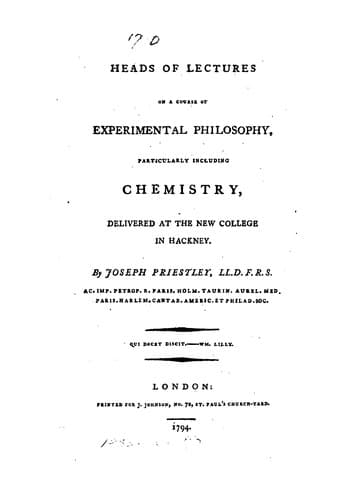
Heads of Lectures on a Course of Experimental Philosophy: Particularly Including ChemistryPriestley, Joseph
Philosophy
Heads of Lectures on a Course of Experimental Philosophy: Particularly Including Chemistry
Priestley, Joseph
Chemistry -- Early works to 1800
The combination of sulphur and arsenic, by melting them together, is of
a red colour, known by the name of _realgal_, or _realgar_. It is less
volatile than orpiment.
The solution of fixed alkali dissolves the calx of arsenic, and by means
of heat a brown tenacious mass is produced, and having also a
disagreeable smell, it is called _liver of arsenic_.
The regulus of arsenic is of a yellow colour, subject to tarnish or grow
black, by exposure to the air, very brittle, and of a laminated texture.
In close vessels it wholly sublimes, but burns with a small flame in
pure air.
Vitriolic acid has little action upon this semi-metal, except when hot;
but the nitrous acid acts readily upon it, and likewise dissolves the
calx, as does boiling marine acid, though it affects it very little when
cold.
Most of the metals unite with the regulus of arsenic.
Dephlogisticated marine acid converts the calx of arsenic into
_arsenical acid_ by giving it pure air.
The acid of arsenic acts more or less upon all metals, but the phenomena
do not appear to be of much importance.
The calx of acid is used in a variety of the arts, especially in the
manufactory of glass. Orpiment and realgar are used as pigments. Some
attempts have been made to introduce it into medicine, but being
dangerous, the experiments should be made with caution.
_Of Cobalt._
Cobalt is a semi-metal of a grey or steel colour, of a close-grained
fracture, more difficult of fusion than copper, not easily calcined. It
soon tarnishes in the air, but water has no effect upon it.
Cobalt, dissolved in _aqua regia_, makes an excellent sympathetic ink,
appearing green when held to the fire, and disappearing when cold,
unless it has been heated too much, when it burns the paper.
The calx of cobalt is of a deep blue colour, which, when fused, makes
the blue glass called _smalt_. The ore of cobalt, called _zaffre_, is
found in several parts of Europe, but chiefly in Saxony. As it is
commonly sold, it contains twice or thrice its weight of powder of
flints. The smalt is usually composed of one part of calcined cobalt,
fused with two parts of powder of flint and one of pot-ash.
The chief use of cobalt is for making smalt; but the powder and the
blue-stone used by laundresses is a preparation made by the Dutch of a
coarse kind of smalt.
_Of Zinc._
Public-domain text, read in full here on John Shaqi.
Reviews
Reviews
No reviews yet
Be the first to share your thoughts on this work.
Join the Discussion
Join the discussion
Sign in to leave a comment or review.
Sign InorCreate an account