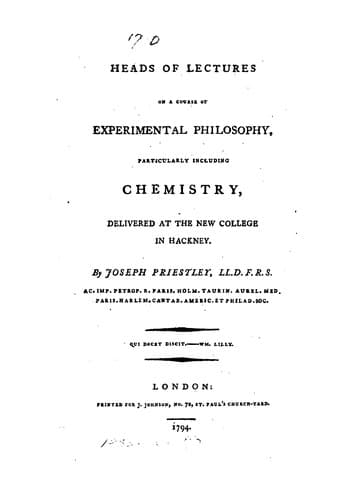
Heads of Lectures on a Course of Experimental Philosophy: Particularly Including ChemistryPriestley, Joseph
Philosophy
Heads of Lectures on a Course of Experimental Philosophy: Particularly Including Chemistry
Priestley, Joseph
Chemistry -- Early works to 1800
Zinc is a semi-metal of a bluish cast, brighter than lead, and so far
malleable as not to be broken by a hammer, though it cannot be much
extended. When broken by bending, it appears to consist of cubical
grains. If it be heated nearly to melting, it will be sufficiently
brittle to be pulverized. It melts long before ignition, and when it is
red hot, it burns with a dazzling white flame, and is calcined with
such rapidity, that its calx flies up in the form of white flowers,
called _flowers of zinc_, or _philosophical wool_. In a stronger heat
they become a clear yellow glass. Heated in close vessels, this metal
rises without decomposition, being the most volatile of all the metals
except the regulus of _arsenic_.
Zinc dissolved in diluted vitriolic acid, yields much inflammable air,
and has a residuum, which appears to be plumbago, and the liquor forms
crystals, called _white copperas_. This metals also yields inflammable
air when dissolved in the marine acid. Dissolved in the nitrous acid, it
yields dephlogisticated nitrous air, with very little proper nitrous
air.
The ore of zinc, called _calamine_, is generally of a white colour; and
the chief use of it is to unite it with copper, with which it makes
brass and other gold-coloured mixtures of metals. The calx and the salts
of this metal are occasionally used in medicine.
LECTURE XXVIII.
_Of Antimony._
The regulus of antimony is of a silvery white colour, of a scaly
texture, very brittle, and melts soon after ignition. By continuance of
heat it calcines in white fumes, called _argentine flowers of antimony_,
which melt into a hyacinthine glass. In close vessels it rises without
decomposition. Its calx is soluble in water, like that of arsenic. This
metal tarnishes, but does not properly rust, by exposure to the air.
This metal is soluble in aqua regia. It detonates with nitre, and what
remains of equal parts of nitre and regulus of antimony after
detonation, in a hot crucible, is called _diaphoretic antimony_. The
water used in this preparation contains a portion of the calx suspended
by the alkali, and being precipitated by an acid, is called _ceruse of
antimony_.
When regulus of antimony is pulverized and mixed with twice its weight
of corrosive sublimate (which is attended with heat) and then distilled
with a gentle fire, a thick fluid comes over, which is congealed in the
receiver, or in the neck of the retort, and is called _butter of
antimony_. The residuum consists of revived mercury, with some regulus
and calx of antimony. When this butter of antimony is thrown into pure
water, there is a white precipitate, called _powder of algaroth_, a
violent emetic. Nitrous acid dissolves the butter of antimony; and when
an equal weight of nitrous acid has been three times distilled to
dryness from butter of antimony, the residuum, after ignition, is called
_bezoar mineral_, and seems to be little more than a calx of the metal.
Public-domain text, read in full here on John Shaqi.
Reviews
Reviews
No reviews yet
Be the first to share your thoughts on this work.
Elsewhere in the archive
Join the Discussion
Join the discussion
Sign in to leave a comment or review.
Sign InorCreate an account