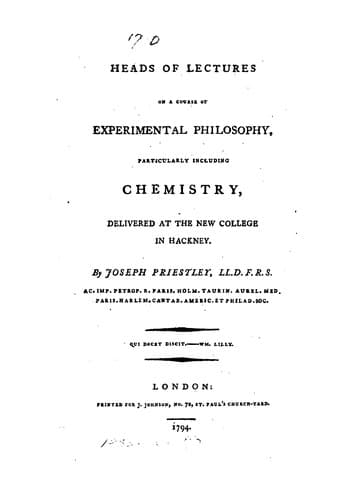
Heads of Lectures on a Course of Experimental Philosophy: Particularly Including ChemistryPriestley, Joseph
Philosophy
Heads of Lectures on a Course of Experimental Philosophy: Particularly Including Chemistry
Priestley, Joseph
Chemistry -- Early works to 1800
Crude antimony, which has been much used in the experiments of
alchemists, is a combination of sulphur and regulus of antimony. Heat
melts it, and finally converts it into glass, of a dark red colour,
called _liver of antimony_. If antimony be melted or boiled with a fixed
alkali, a precipitate is made by cooling, called _kermes mineral_,
formerly used in medicine. The antimonial preparations that are now most
in use are _antimonial wine_ and _tartar emetic_. The wine is made by
infusing pulverized glass of antimony in Spanish wine some days, and
filtering the clear fluid through paper. The emetic tartar, or
antimonial tartar, is a saline substance, composed of acid of tartar,
vegetable alkali, and antimony partially calcined. The preparation may
be seen in the Dispensaries.
The regulus of antimony is used in the form of pills, which purge more
or less in proportion to the acid they meet with; and as they undergo
little or no change in passing through the body, they are called
_perpetual pills_.
_Of Manganese._
Manganese is a hard, black mineral, very ponderous, and the regulus of
it is a semi-metal of a dull white colour when broken, but soon grows
dark by exposure to the air. It is hard and brittle, though not
pulverizable, rough in its fracture, and of very difficult fusion. Its
calces are white when imperfect, but black, or dark green, when perfect.
The white calx is soluble in acids. When broken in pieces, it falls into
powder by a spontaneous calcination, and this powder is magnetical,
though the mass was not possessed of that property. The black calx of
manganese is altogether insoluble in acids. It contains much
dephlogisticated air.
The calx of manganese is used in making glass; the glass destroying the
colour of that of the other materials, and thereby making the whole mass
transparent.
This semi-metal mixes with most of the metals in fusion, but not with
mercury.
There is another ore of manganese, called _black woad_, which inflames
spontaneously when mixed with oil.
_Of Wolfram._
Wolfram is a mineral of a brownish or black colour, found in the tin
mines of Cornwall, of a radiated or foliated texture, shining almost
like a metal. It contains much of the calx of manganese, and iron; but
when the substance is pulverized, these are easily dissolved, and the
calx of wolfram is found to be yellow.
This calx turns blue by exposure to light; and an hundred grains of it
heated with charcoal will yield sixty grains of a peculiar metal, in
small particles, which, when broken, look like steel. It is soluble in
the vitriolic or marine acids, and reduced to a yellow calx by nitrous
acid or aqua regia.
_Of Molybdena._
Public-domain text, read in full here on John Shaqi.
Reviews
Reviews
No reviews yet
Be the first to share your thoughts on this work.
Elsewhere in the archive
Join the Discussion
Join the discussion
Sign in to leave a comment or review.
Sign InorCreate an account