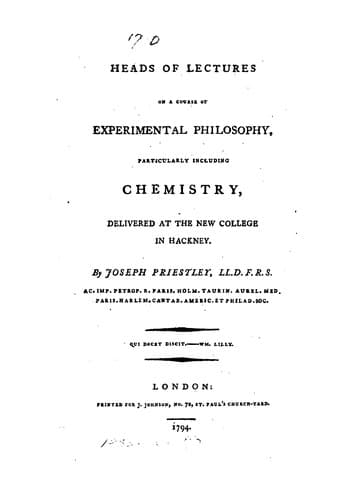
Heads of Lectures on a Course of Experimental Philosophy: Particularly Including ChemistryPriestley, Joseph
Philosophy
Heads of Lectures on a Course of Experimental Philosophy: Particularly Including Chemistry
Priestley, Joseph
Chemistry -- Early works to 1800
Molybdena is a substance which much resembles plumbago; but its texture
is scaly, and not easily pulverized, on account of a degree of
flexibility which its laminae possess. With extreme heat, and mixed with
charcoal, it yields small particles of a metal that is grey, brittle,
and extremely infusible; and uniting with several of the metals, it
forms with them brittle or friable compounds. By heat it is converted
into a white calx.
_Of Solid Combustible Substances._
There yet remains a class of solid substances, of the _combustible_
kind, but most of them have been already considered under the form of
the fluids, from which they are originally formed, as _bitumen_,
_pit-coal_, and _amber_; or under the principal ingredients of which
they are composed, as _sulphur_ and _plumbago_.
There only remains to be mentioned the _diamond_, which is of a nature
quite different from that of the other precious stones, the principal
ingredient in which is siliceous earth, which renders them not liable to
be much affected by heat. On the contrary, the diamond is a combustible
substance; for in a degree of heat somewhat greater than that which will
melt silver, it burns with a slight flame, diminishes common air, and
leaves a soot behind. Also, if diamond powder be triturated with
vitriolic acid, it turns it black, which is another proof of its
containing phlogiston.
The diamond is valued on account of its extreme hardness, the exquisite
polish it is capable of, and its extraordinary refractive power; for
light falling on its interior surface with an angle of incidence greater
than 24-1/2 will be wholly reflected, whereas in glass it requires an angle
of 41 degrees.
LECTURE XXIX.
_Of the Doctrine of Phlogiston and the Composition of Water._
It was supposed to be a great discovery of Mr. Stahl, that all
inflammable substances, as well as metals, contain a principle, or
substance, to which he gave the name of phlogiston, and that the
addition or deprivation of this substance makes some of the most
remarkable changes in bodies, especially that the union of a metallic
calx and this substance makes a metal; and that combustion consists in
the separation of phlogiston from the substances that contain it. That
it is the same principle, or substance, that enters into all inflammable
substances, and metals, is evident, from its being disengaged from any
of them, and entering into the composition of any of the others. Thus
the phlogiston of charcoal or inflammable air becomes the phlogiston of
any of the metals, when the calx is heated in contact with either of
them.
On the contrary, Mr. Lavoisier and most of the French chemists, are of
opinion, that there is no such principle, or substance, as phlogiston;
that metals and other inflammable bodies are simple substances, which
have an affinity to pure air; and that combustion consists not in the
separation of any thing from the inflammable substance, but in the union
of pure air with it.
Public-domain text, read in full here on John Shaqi.
Reviews
Reviews
No reviews yet
Be the first to share your thoughts on this work.
Elsewhere in the archive
Join the Discussion
Join the discussion
Sign in to leave a comment or review.
Sign InorCreate an account