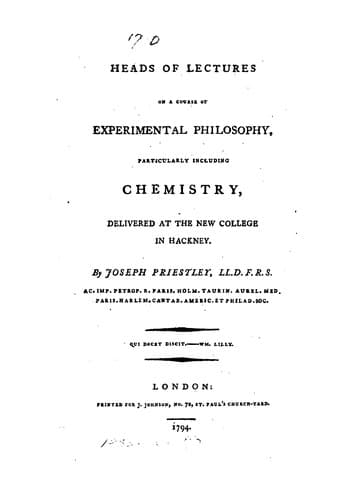
Heads of Lectures on a Course of Experimental Philosophy: Particularly Including ChemistryPriestley, Joseph
Philosophy
Heads of Lectures on a Course of Experimental Philosophy: Particularly Including Chemistry
Priestley, Joseph
Chemistry -- Early works to 1800
They moreover say, that water is not, as has been commonly supposed, a
simple substance, but that it consists of two elements, viz. pure air,
or _oxygene_, and another, to which they give the name of _hydrogene_,
which, with the principle of _heat_, called by them _calorique_, is
inflammable air.
The principal fact adduced by them to prove that metals do not lose any
thing when they become calces, but only gain something, is, that mercury
becomes a calx, called _precipitate per se_, by imbibing pure air, and
that it becomes running mercury again by parting with it.
This is acknowledged: but it is almost the only case of any calx being
revived without the help of some known phlogistic substance; and in this
particular case it is not absurd to suppose, that the mercury, in
becoming precipitate per se, may retain all its phlogiston, as well as
imbibe pure air, and therefore be revived by simply parting with that
air. In many other cases the same metal, in different states, contains
more or less phlogiston, as cast iron, malleable iron, and steel. Also
there is a calx of mercury made by the acid of vitriol, which cannot be
revived without the help of inflammable air, or some other substance
supposed to contain phlogiston: and that the inflammable air is really
imbibed in these processes, is evident, from its wholly disappearing,
and nothing being left in the vessel in which the process is made beside
the metal that is revived by it. If precipitate per se be revived in
inflammable air, the air will be imbibed, so that running mercury may
contain more or less phlogiston.
The antiphlogistians also say, that the diminution of atmospherical air
by the burning of phosphorus is a proof of their theory; the pure air
being imbibed by that substance, and nothing emitted from it. But there
is the same proof of phosphorus containing phlogiston, that there is of
dry flesh containing it; since the produce of the solution of it in
nitrous acid, and its effect upon the acid, are the same, viz. the
production of phlogisticated air, and the phlogistication of the acid.
Their proof that water is decomposed, is, that in sending steam over hot
iron, inflammable air (which they suppose to be one constituent part of
it) is procured; while the other part, viz. the oxygene, unites with the
iron, and adds to its weight. But it is replied, that the inflammable
air may be well supposed to be the phlogiston of the iron, united to
part of the water, as its base, while the remainder of the water is
imbibed by the calx; and that it is mere water, and not pure air, or
oxygene, that is retained in the iron, is evident, from nothing but pure
water being recovered when this calx of iron is revived in inflammable
air, in which case the inflammable air wholly disappears, taking the
place of the water, by which it had been expelled.
Public-domain text, read in full here on John Shaqi.
Reviews
Reviews
No reviews yet
Be the first to share your thoughts on this work.
Elsewhere in the archive
Join the Discussion
Join the discussion
Sign in to leave a comment or review.
Sign InorCreate an account