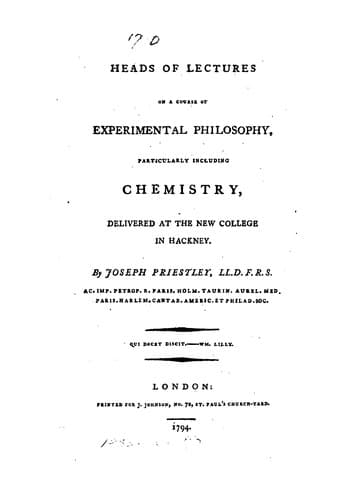
Heads of Lectures on a Course of Experimental Philosophy: Particularly Including ChemistryPriestley, Joseph
Philosophy
Heads of Lectures on a Course of Experimental Philosophy: Particularly Including Chemistry
Priestley, Joseph
Chemistry -- Early works to 1800
In answer to this it is said, that the pure air expelled from the calx
uniting with the inflammable air in the vessel, recomposes the water
found after this process. But in every other case in which any substance
containing pure air is heated in inflammable air, though the inflammable
air be in part imbibed, some _fixed air_ is produced, and this fixed air
is composed of the pure air in the substance and part of the inflammable
air in the vessel. Thus, if _minium_, which contains pure air, and
_massicot_, which contains none, be heated in inflammable air, in both
the cases lead will be revived by the absorption of inflammable air; but
in the former case only, and not in the latter, will fixed air be
produced. The calx of iron, therefore, having the same effect with
massicot, when treated in the same manner, appears to contain no more
pure air than massicot does.
Besides this explanation of the facts on which the new theory is
founded, which shews it to be unnecessary, the old hypothesis being
sufficient for the purpose, some facts are alledged, as inconsistent
with the new doctrine.
If the calx of iron made by water, and charcoal made by the greatest
degree of heat, be mixed together, a great quantity of inflammable air
will be produced; though, according to the new theory, neither of these
substances contained any water, which they maintain to be the only
origin of it. But this fact is easily explained upon the doctrine of
phlogiston; the water in this calx uniting with the phlogiston of the
charcoal, and then forming inflammable air; and it is the same kind of
inflammable air that is made from charcoal and water.
Also the union of inflammable and pure air, when they are fired together
by means of the electric spark, produces not pure water, as, according
to the new theory, it ought to do, but _nitrous acid_.
To this it has been objected, that the acid thus produced came from the
decomposition of phlogisticated air, a small portion of which was at
first contained in the mixture of the two kinds of air. But when every
particle of phlogisticated air is excluded, the strongest acid is
procured.
They find, indeed, that by the slow burning of inflammable air in pure
air, they get pure water. But then it appears, that whenever this is the
case, there is a production of phlogisticated air, which contains the
necessary element of nitrous acid; and this is always the case when
there is a little surplus of the inflammable air that is fired along
with the pure air, as the acid is always procured when there is a
redundancy of pure air.
That much water should be procured by the decomposition of these kinds
of air, is easily accounted for, by supposing that water, or steam, is
the basis of these, as well as of all other kinds of air.
Public-domain text, read in full here on John Shaqi.
Reviews
Reviews
No reviews yet
Be the first to share your thoughts on this work.
Elsewhere in the archive
Join the Discussion
Join the discussion
Sign in to leave a comment or review.
Sign InorCreate an account