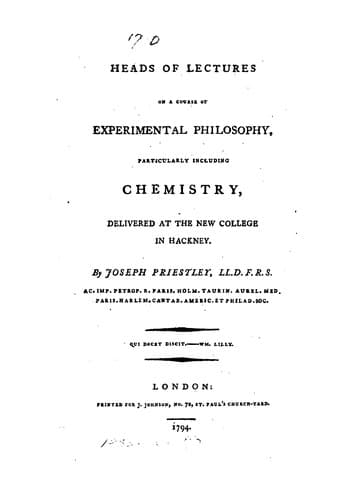
Heads of Lectures on a Course of Experimental Philosophy: Particularly Including ChemistryPriestley, Joseph
Philosophy
Heads of Lectures on a Course of Experimental Philosophy: Particularly Including Chemistry
Priestley, Joseph
Chemistry -- Early works to 1800
Since air something better than that of the atmosphere is constantly
produced from water by converting it into vapour, and also by removing
the pressure of the atmosphere, and these processes do not appear to
have any limits; it seems probable, that _water_ united to the principle
of _heat_; constitutes atmospherical air; and if so, it must consist of
the elements of both dephlogisticated and phlogisticated air; which is a
supposition very different from that of the French chemists.
LECTURE XXX.
_Of Heat._
Heat is an affection of bodies well known by the sensation that it
excites. It is produced by friction or compression, as by the striking
of flint against steel, and the hammering of iron, by the reflection or
refraction of light, and by the combustion of inflammable substances.
It has been long disputed, whether the cause of heat be properly a
_substance_, or some particular affection of the particles that compose
the substance that is heated. But be it a substance, or a principle of
any other kind, it is capable of being transferred from one body to
another, and the communication of it is attended with the following
circumstances. All substances are expanded by heat, but some in a
greater degree than others; as metals more than earthy substances, and
charcoal more than wood. Also some receive and transmit heat through
their substance more readily than others; metals more so than earths,
and of the metals, copper more readily than iron. Instruments contrived
to ascertain the expansion of substances by heat, are called
_pyrometers_, and are of various constructions.
As a standard to measure the degrees of heat, mercury is in general
preferable to any other substance, on account of its readily receiving,
and communicating, heat through its whole mass. _Thermometers_,
therefore, or instruments to measure the degrees of heat, are generally
constructed of it, though, as it is subject to become solid in a great
degree of cold, ardent spirit, which will not freeze at all, is more
proper in that particular case.
The graduation of thermometers is arbitrary. In that of Fahrenheit,
which is chiefly used in England, the freezing point of water is 32 deg.,
and the boiling point 212 deg. In that of Reaumur, which is chiefly used
abroad, the freezing point of water is 0, and the boiling point 80. To
measure the degrees of heat above ignition, Mr. Wedgwood has happily
contrived to use pieces of clay, which contract in the fire; and he has
also been able to find the coincidence of the degrees in mercurial
thermometers with those of his own.
Public-domain text, read in full here on John Shaqi.
Reviews
Reviews
No reviews yet
Be the first to share your thoughts on this work.
Elsewhere in the archive
Join the Discussion
Join the discussion
Sign in to leave a comment or review.
Sign InorCreate an account