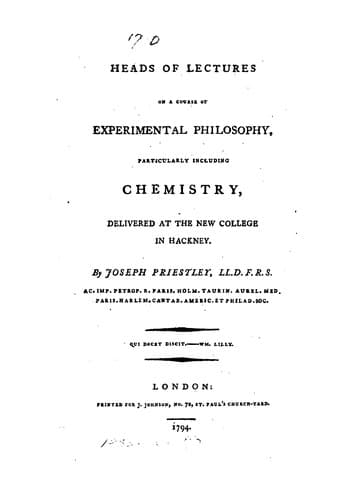
Heads of Lectures on a Course of Experimental Philosophy: Particularly Including ChemistryPriestley, Joseph
Philosophy
Heads of Lectures on a Course of Experimental Philosophy: Particularly Including Chemistry
Priestley, Joseph
Chemistry -- Early works to 1800
To measure the degrees of heat and cold during a person's absence, Lord
George Cavendish contrived an instrument, in which a small bason
received the mercury, that was raised higher than the place for which it
was regulated by heat or cold, without a power of returning. But Mr. Six
has lately hit upon a better method, viz. introducing into the tube of
his thermometer a small piece of iron, which is raised by the ascent of
the mercury, and prevented from descending by a small spring; but which
may be brought back to its former place by a magnet acting through the
glass.
Heat, like light, is propagated in right lines; and what is more
remarkable, cold observes the same laws. For if the substance emitting
heat without light, as iron below ignition, be placed in the focus of a
burning mirror, a thermometer in the focus of a similar mirror, placed
parallel to it, though at a considerable distance, will be heated by it,
and if a piece of ice be placed there, the mercury will fall.
Heat assists the solvent power of almost all menstrua; so that many
substances will unite in a certain degree of heat, which will form no
union at all without it, as dephlogisticated and inflammable air.
If substances be of the same kind, they will receive heat from one
another, in proportion to their masses. Thus, if a quantity of water
heated to 40 deg. be mixed with another equal quantity of water heated to
20 deg., the whole mass will be heated to 30 deg. But if the substances be of
different kinds, they will receive heat from each other in different
proportions, according to their _capacity_ (as it is called) of
receiving heat. Thus, if a pint of mercury of the temperature of 136 be
mixed with a pint of water of the temperature of 50, the temperature of
the two after mixture will not be a medium between those two numbers,
viz. 93, but 76; consequently the mercury was cooled 60 deg., while the
water was heated only 26; so that 26 degrees of heat in water correspond
to 60 in mercury. But mercury is about 13 times specifically heavier
than water, so that an equal weight of mercury would contain only one
thirtieth part of this heat; and dividing 26 by 13, the quotient is 2.
If _weight_, therefore, be considered, the heat discovered by water
should be reckoned as 2 instead of 60; and consequently when water
receives 2 degrees of heat, an equal weight of mercury will receive 60 deg.;
and dividing both the numbers by 2, if the heat of water be 1, that of
the mercury will be 30. Or since they receive equal degrees of heat,
whether they discover it or not (and the less they discover, the more
they retain in a latent state) a pound of mercury contains no more than
one thirtieth part of the heat actually existing in a pound of water of
the same temperature. Water, therefore, is said to have a greater
capacity for receiving and retaining heat, without discovering it, than
mercury, in the proportion of 30 to 1, if weight be considered, or of
Public-domain text, read in full here on John Shaqi.
Reviews
Reviews
No reviews yet
Be the first to share your thoughts on this work.
Elsewhere in the archive
Join the Discussion
Join the discussion
Sign in to leave a comment or review.
Sign InorCreate an account