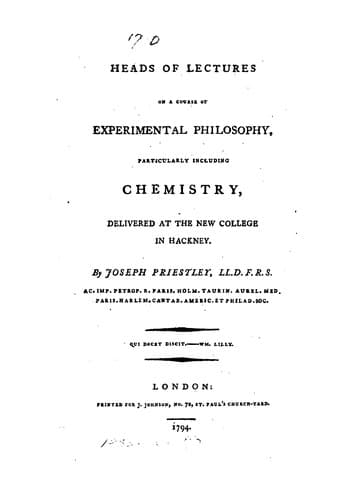
Heads of Lectures on a Course of Experimental Philosophy: Particularly Including ChemistryPriestley, Joseph
Philosophy
Heads of Lectures on a Course of Experimental Philosophy: Particularly Including Chemistry
Priestley, Joseph
Chemistry -- Early works to 1800
60 to 26, that is of 30 to 13; if _bulk_ be the standard, though,
according to some, it is as 3 to 2.
The capacity of receiving heat in the substance is greatest in a state
of vapour, and least in that of a solid; so that when ice is converted
into water, heat is absorbed, and more still when it is converted into
vapour; and on the contrary, when vapour is converted into water, it
gives out the heat which it had imbibed, and when it becomes ice it
gives out still more.
If equal quantities of ice and water be exposed to heat at the
temperature of 32 deg., the ice will only become water, without receiving
any additional sensible heat; but an equal quantity of water in the same
situation would be raised to 178 deg., so that 146 degrees of heat will be
imbibed, and remain in latent in the water, in consequence of its
passing from a state of ice: and heat communicated by a given weight of
vapour will raise an equal weight of a nonevaporable substance, of the
same capacity with water, 943 degrees; so that much more heat is latent
in steam, than in the water from which it was formed.
This doctrine of latent heat explains a great variety of phaenomena in
nature; as that of cooling bodies by evaporation, the vapour of water,
or any other fluid substance, absorbing and carrying off the heat they
had before.
Water, perfectly at rest, will fall considerably below the freezing
point, and yet continue fluid: but on the slightest agitation, the
congelation of the whole, or part of it, takes place instantly, and if
the whole be not solid, it will instantly rise to 32 deg., the freezing
point. From whatever cause, some motion seems necessary to the
commencement of congelation, at least in a moderate temperature; but
whenever any part of the water becomes solid, it gives out some of the
heat it had before, and that heat which was before latent becoming
sensible, and being diffused through the whole mass, raises its
temperature.
On the same principle, when water heated higher than the boiling point
in a digester is suddenly permitted to escape in the form of steam, the
remainder is instantly reduced to the common boiling point, the heat
above that point being carried off in a latent state by the steam.
Had it not been for this wise provision in nature, the whole of any
quantity of water would, in all cases of freezing, have become solid at
once; and also the whole of any quantity that was heated to the point of
boiling, would have been converted into steam at once; circumstances
which would have been extremely inconvenient, and often fatal.
Public-domain text, read in full here on John Shaqi.
Reviews
Reviews
No reviews yet
Be the first to share your thoughts on this work.
Elsewhere in the archive
Join the Discussion
Join the discussion
Sign in to leave a comment or review.
Sign InorCreate an account