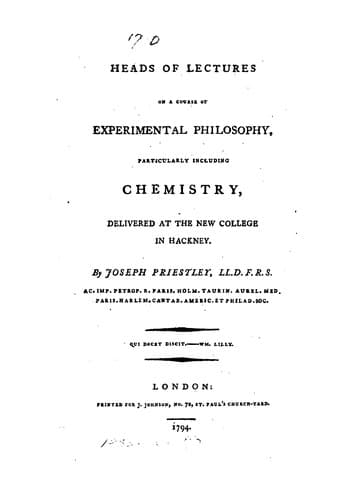
Heads of Lectures on a Course of Experimental Philosophy: Particularly Including ChemistryPriestley, Joseph
Philosophy
Heads of Lectures on a Course of Experimental Philosophy: Particularly Including Chemistry
Priestley, Joseph
Chemistry -- Early works to 1800
This doctrine also explains the effect of freezing mixtures, as that of
salt and snow. These solid substances, on being mixed, become fluid, and
that fluid absorbing much heat, deprives all the neighbouring bodies of
part of what they had. But if the temperature at which the mixture is
made be as low as that to which this mixture would have brought it, it
has no effect, and in a lower temperature this new fluid would become
solid; for that mixture has only a certain determinate capacity for
heat, and if the neighbouring bodies have less heat, they will take
from it.
It has been observed, that the comparative heat of bodies containing
phlogiston is increased by calcination or combustion; so that the calx
of iron has a greater capacity for heat, and therefore contains more
latent heat, than the metal.
In general it is not found, that the same substances have their capacity
for receiving heat increased by an increase of temperature; but this is
said to be the case with a mixture of ardent spirit and water, and also
that of spirit of vitriol and water.
Since all substances contain a greater or less quantity of heat, and in
consequence of being deprived of it become colder and colder, it is a
question of some curiosity to determine the extent to which this can go,
or at what degree in the scale of a thermometer any substance would be
absolutely cold, or deprived of all heat; and an attempt has been made
to solve this problem in the following manner. Comparing the capacity of
water with that of ice, by means of a third substance, viz. mercury, it
has been found, that if that of ice be 9 deg., that of water is 10 deg.; so that
water in becoming ice gives out one tenth part of its whole quantity of
heat. But it has been shown, that ice in becoming water absorbs 146
degrees of heat. This, therefore, being one tenth part of the whole heat
of water, it must have contained 1460 degrees; so that taking 32
degrees, which is the freezing point, from that number, the point of
absolute cold will be 1426 below 0 of Fahrenheit's scale.
By a computation, made by means of the heat of inflammable and
dephlogisticated air, at the temperature of 50, Dr. Crawford finds, that
it contains nearly 1550 degrees of heat; so that the point of absolute
cold will be 1500 below 0. But more experiments are wanted to solve this
curious problem to entire satisfaction.
LECTURE XXXI.
_Of Animal Heat._
Since all animals, and especially those that have red blood, are much
hotter than the medium in which they live, the source of this heat has
become the subject of much investigation; and as the most probable
theory is that of Dr. Crawford, I shall give a short detail of the
reasons on which it is founded.
Public-domain text, read in full here on John Shaqi.
Reviews
Reviews
No reviews yet
Be the first to share your thoughts on this work.
Elsewhere in the archive
Join the Discussion
Join the discussion
Sign in to leave a comment or review.
Sign InorCreate an account