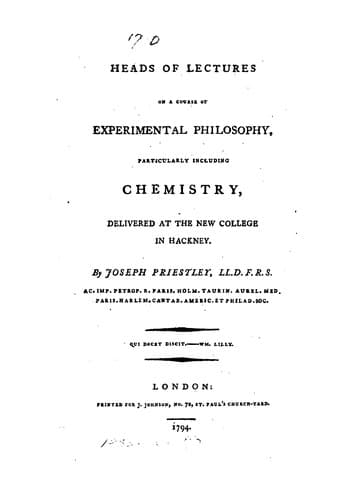
Heads of Lectures on a Course of Experimental Philosophy: Particularly Including ChemistryPriestley, Joseph
Philosophy
Heads of Lectures on a Course of Experimental Philosophy: Particularly Including Chemistry
Priestley, Joseph
Chemistry -- Early works to 1800
Having, with the most scrupulous attention, ascertained the _latent_,
or, as he calls it, the _absolute_ heat of blood, and also that of the
aliments of which it is composed, he finds that it contains more than
could have been derived from _them_. Also finding that the absolute heat
of arterial blood exceeds that of venous blood, in the proportion of 11-1/2
to 10, he concludes that it derives its heat from the air respired in
the lungs, and that it parts with this _latent_ heat, so that it becomes
sensible, in the course of its circulation, in which it becomes loaded
with phlogiston, which it communicates to the air in the lungs.
That this heat is furnished by the _air_, he proves, by finding, that
that which we inspire contains more heat than that which we expire, or
than the aqueous humor which we expire along with it, in a very
considerable proportion; so that if the heat contained in the pure air
did not become latent in the blood, it would raise its temperature
higher than that of red-hot iron. And again, if the venous blood, in
being converted into arterial blood, did not receive a supply of latent
heat from the air, its temperature would fall from 96 to 104 below 0 in
Fahrenheit's thermometer.
That the heat procured by combustion has the same source, viz. the
dephlogisticated air that is decomposed in the process, is generally
allowed; and Dr. Crawford finds, that when equal portions of air are
altered by the respiration of a Guinea pig, or by the burning of
charcoal, the quantity of heat communicated by the two processes is
nearly equal.
The following facts are also alleged in favour of his theory. Whereas
animals which have much red blood, and respire much, have the power of
keeping themselves in a temperature considerably higher than that of the
surrounding atmosphere, other animals, as _frogs_ and _serpents_, are
nearly of the same temperature with it; and those animals which have the
largest respiratory organs, as birds, are the warmest; also the degree
of heat is in some measure proportionable to the quantity of air that is
respired in a given time, as in violent exercise.
It has been observed, that animals in a medium hotter than the blood
have a power of preserving themselves in the same temperature. In this
case the heat is probably carried off by perspiration, while the blood
ceases to receive, or give out, any heat; and Dr. Crawford finds, that
when an animal is placed in a warm medium the colour of the venous blood
approaches nearer to that of the arterial than when it is placed in a
colder medium; and also, that it phlogisticates the air less than in the
former case; so that in these circumstances respiration has not the same
effect that it has in a colder temperature, in giving the body an
additional quantity of heat; which is an excellent provision in nature,
as the heat is not wanted, but, on the contrary, would prove
inconvenient.
LECTURE XXXII.
_Of Light._
Public-domain text, read in full here on John Shaqi.
Reviews
Reviews
No reviews yet
Be the first to share your thoughts on this work.
Elsewhere in the archive
Join the Discussion
Join the discussion
Sign in to leave a comment or review.
Sign InorCreate an account