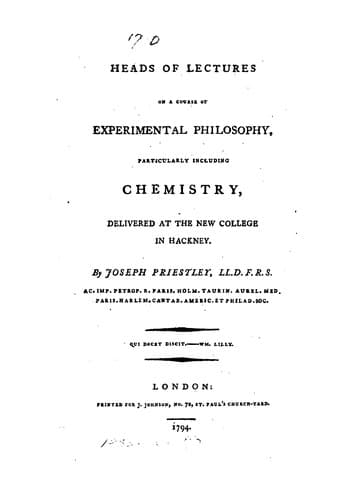
Heads of Lectures on a Course of Experimental Philosophy: Particularly Including ChemistryPriestley, Joseph
Philosophy
Heads of Lectures on a Course of Experimental Philosophy: Particularly Including Chemistry
Priestley, Joseph
Chemistry -- Early works to 1800
Another most important agent in nature, and one that has a near
connexion with heat, is _light_, being emitted by all bodies in a state
of ignition, and especially by the sun, the great source of light and of
heat to this habitable world.
Whether light consists of particles of matter (which is most probable)
or be the undulation of a peculiar fluid, filling all space, it is
emitted from all luminous bodies in right lines.
Falling upon other bodies, part of the light is _reflected_ at an angle
equal to that of its incidence, though not by impinging on the
reflecting surface, but by a power acting at a small distance from it.
But another part of the light enters the body, and is _refracted_ or
bent _towards_, or _from_, the perpendicular to the surface of the new
medium, if the incidence be oblique to it. In general, rays of light
falling obliquely on any medium are bent as if they were attracted by
it, when it has a greater density, or contains more of the inflammable
principle, than the medium through which it was transmitted to it. More
of the rays are reflected when they fall upon a body with a small degree
of obliquity to its surface, and more of them are transmitted, or enter
the body, when their incidence is nearer to a perpendicular.
The velocity with which light is emitted or reflected is the same, and
so great that it passes from the sun to the earth in about eight
minutes and twelve seconds.
Rays of light emitted or reflected from a body entering the pupil of the
eye, are so refracted by the humours of it, as to be united at the
surface of the retina, and so make images of the objects, by means of
which they are visible to us; and the magnifying power of telescopes or
microscopes depends upon contriving, by means of reflections or
refractions, that pencils of rays issuing from every point of any object
shall first diverge, and then converge, as they would have done from a
much larger object, or from one placed much nearer to the eye.
When a beam of light is bent out of its course by refraction, all the
rays of which it consists are not equally refracted, but some of them
more and others less; and the colour which they are disposed to exhibit
is connected invariably with the degree of their refrangibility; the
red-coloured rays being the least, and the violet the most refrangible,
and the rest being more or less so in proportion to their nearness to
these, which are the extremes, in the following order, violet, indigo,
blue, green, yellow, orange, red.
These colours, when separated as much possible, are still contiguous;
and all the shades of each colour have likewise their separate and
invariable degrees of refrangibility. When separated as distinctly as
possible, they divide the whole space between them exactly as a musical
chord is divided in order to found the several notes and half notes of
an octave.
Public-domain text, read in full here on John Shaqi.
Reviews
Reviews
No reviews yet
Be the first to share your thoughts on this work.
Elsewhere in the archive
Join the Discussion
Join the discussion
Sign in to leave a comment or review.
Sign InorCreate an account