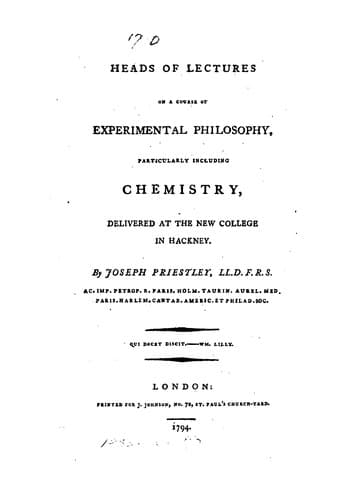
Heads of Lectures on a Course of Experimental Philosophy: Particularly Including ChemistryPriestley, Joseph
Philosophy
Heads of Lectures on a Course of Experimental Philosophy: Particularly Including Chemistry
Priestley, Joseph
Chemistry -- Early works to 1800
There is, consequently, a very eager attraction between these two
electricities with which the different sides of the plate are charged,
and when a proper communication is made by means of conductors, a flash
of electric light, attended with a report (which is greater or less in
proportion to the quantity of electricity communicated to them, and the
goodness of the conductors) is perceived between them, and the
electricity of both sides is thereby discharged.
The substance of the glass itself in, or upon, which these electricities
exist, is impervious to electricity, and does not permit them to unite;
but if they be very strong, and the plate of glass very thin, they will
force a passage through the glass. This, however, always breaks the
glass, and renders it incapable of another charge.
The flash of light, together with the explosion between the two opposite
sides of a charged electric, is generally called the _electric shock_,
on account of the disagreeable sensation it gives any animal whose body
is made use of to form the communication been them.
The electric shock is always found to perform the circuit from one side
of the charged glass to the other by the shortest passage through the
best conductors. Common communicated electricity also observes the same
rule in its transmission from one body to another.
It has not been found, that the electric shock takes up any sensible
space of time in being transmitted to the greatest distances.
The electric shock, as also the common electric spark, displaces the air
through which it passes; and if its passage from conductor to conductor
be interrupted by non-conductors of a moderate thickness, it will rend
and tear them in its passage, in such a manner as to exhibit the
appearance of a sudden expansion of the air about the center of the
shock.
If the electric circuit be interrupted, the electric matter, during the
discharge, will pass to any other body that lies near its path, and
instantly return. This may be called the _lateral explosion_. The effect
of this lateral explosion through a brass chain, when the quantity of
electricity is very great, will be the discolouring and partial burning
of the paper on which it lies.
If a great quantity of electricity be accumulated, as in a _battery_,
the explosion will pass over the surfaces of imperfect conductors
without entering them, and the effect will be a strong _concussion_ of
the substance. Also the electric matter thus accumulated and condensed
will, by its repulsion, form _concentric circles_, which will appear by
melting the surface of a flat piece of metal on which the explosion is
received.
If an electric shock, or strong spark, be made to pass through, or over,
the belly of a muscle, it forces it to contract, as in a convulsion.
If a strong shock be sent through a small animal body, it will often
deprive it instantly of life.
Public-domain text, read in full here on John Shaqi.
Reviews
Reviews
No reviews yet
Be the first to share your thoughts on this work.
Elsewhere in the archive
Join the Discussion
Join the discussion
Sign in to leave a comment or review.
Sign InorCreate an account