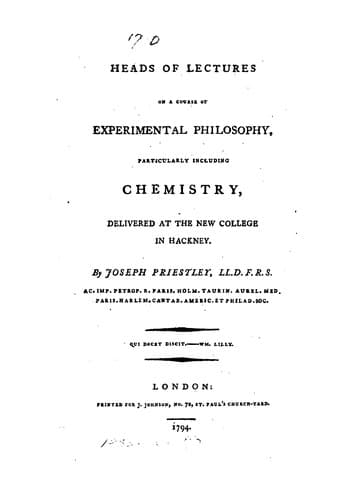
Heads of Lectures on a Course of Experimental Philosophy: Particularly Including ChemistryPriestley, Joseph
Philosophy
Heads of Lectures on a Course of Experimental Philosophy: Particularly Including Chemistry
Priestley, Joseph
Chemistry -- Early works to 1800
The effect of pointed bodies is best explained on the supposition of the
electric matter in one body repelling that in another; and consequently
the electricity belonging to a body with a large surface making a
greater resistance to the entrance of foreign electricity than that
belonging to a smaller.
These two electricities, viz. that of the excited electric, and that of
the rubber, though similar to, are the reverse of, one another. A body
attracted by the one will be repelled by the other, and they will
attract, and in all respects act upon, one another more sensibly than
upon other bodies; so that two pieces of glass or silk possessed of
contrary electricities will cohere firmly together, and require a
considerable force to separate them.
These two electricities having been first discovered by producing one of
them from glass, and the other from amber, sealing-wax, sulphur, rosin,
&c. first obtained the names of _vitreous_ and _resinous_ electricity;
and it being afterwards imagined that one of them was a redundancy, and
the other a deficiency, of a supposed electric fluid, the former has
obtained the name of _positive_, and the latter that of _negative_,
electricity; and these terms are now principally in use.
Positive and negative electricity may be distinguished from each other
by the manner in which they appear at the points of bodies. From a
pointed body electrified positively, there issues a stream of light,
divided into denser streams, at the extremities; whereas, when the point
is electrified negatively, the light is more minutely divided, and
diffused equally. The former of these is called a _brush_, and the
latter a _star_.
If a conductor not insulated be brought within the atmosphere (that is
the sphere of action) of any electrified body, it acquires the
electricity opposite to that of the electrified body, and the nearer it
is brought, the stronger opposite electricity does it acquire, till the
one receive a spark from the other, and then the electricity of both
will be discharged.
The electric substance which separates the two conductors possessing
these two opposite kinds of electricity, is said to be _charged_.
Plates of glass are the most convenient for this purpose, and the
thinner the plate the greater is the charge it is capable of holding.
The conductors contiguous to each side of the glass are called their
_coating_.
Agreeably to the above-mentioned general principle, it is necessary that
one side of the charged glass have a communication with the rubber,
while the other receives the electricity from the conductor, or with the
conductor, while the other receives from the rubber.
It follows also, that the two sides of the plate thus charged are always
possessed of the two opposite electricities; that side which
communicates with the excited electric having the electricity of the
electric, and that which communicates with the rubber, that of the
rubber.
Public-domain text, read in full here on John Shaqi.
Reviews
Reviews
No reviews yet
Be the first to share your thoughts on this work.
Elsewhere in the archive
Join the Discussion
Join the discussion
Sign in to leave a comment or review.
Sign InorCreate an account