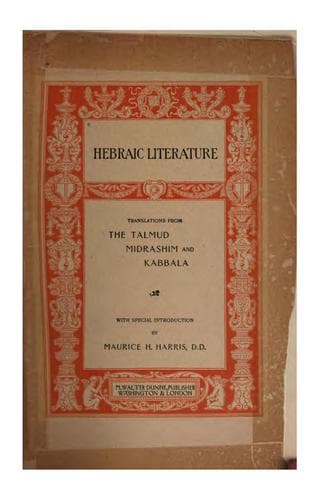
Hebraic Literature; Translations from the Talmud, Midrashim and Kabbala
Religion
Hebraic Literature; Translations from the Talmud, Midrashim and Kabbala
Hebrew literature -- Translations into English
"An Ammonite or Moabite shall not enter the congregation of the Lord,
even to the tenth generation," etc. (Deut. xxiii. 4). One day Yehuda, an
Ammonite prophet, came into the academy and asked, "May I enter the
congregation (if I marry a Jewess)?" Rabban Gamliel said unto him, "Thou
art not at liberty to do so;" but Rabbi Joshua interposed and
maintained, "He is at liberty to do so." Then Rabban Gamliel appealed to
Scripture, which saith, "An Ammonite or Moabite shall not enter into the
congregation of the Lord, even to the tenth generation." To this Rabbi
Joshua retorted and asked, "Are then these nations still in their own
native places? Did not Sennacherib, the king of Assyria, transplant the
nations? as it is said (Isa. x. 13), 'I have removed the bounds of the
people, and have robbed their treasures, and have put down the valor of
the inhabitants.'" Rabban Gamliel replied, "Scripture saith (Jer. xlix.
6), 'Afterward I will bring again the captivity of the children of
Ammon,' and so," he argued, "they must have already returned." Rabbi
Joshua then promptly rejoined, "Scripture saith (Jer. xxx. 3), 'I will
bring again the captivity of my people Israel and Judah,' and these have
not returned yet." And on this reasoning the proselyte was permitted to
enter the congregation.
_Yadayim_, chap. 4, mish. 4.
Go and learn from the tariff of donkey-drivers, ten miles for one zouz,
eleven for two zouzim.
_Chaggigah_, fol. 9, col. 2.
When Israel went up to Jerusalem to attend the festivals, they had to
stand in the Temple court closely crowded together, yet when prostrated
there was a wide space between each of them (Rashi says about four
ells), so that they could not hear each other's confession, which might
have caused them to blush. They had, however, when prostrated, to extend
eleven ells behind the Holy of Holies.
_Yoma_, fol. 21, col. 1,
In the days of Joel, the son of Pethuel, there was a great dearth,
because (as is said in Joel i. 4) "That which the palmerworm hath left
hath the locust eaten," etc. That year the month of Adar (about March)
passed away and no rain came. When some rain fell, during the following
month, the prophet said unto Israel, "Go ye forth and sow." They
replied, "Shall he who has but a measure or two of wheat or barley eat
and live or sow it and die?" Still the prophet urged, "Go forth and
sow." Then they obeyed the prophet, and in eleven days the seed had
grown and ripened; and it is with reference to that generation that it
is said (Ps. cxxvi. 5), "They that sow in tears shall reap in joy."
_Taanith_ fol. 5, col. 1.
What is a female in her minority? One who is between eleven years and
one day, and twelve years and one day. When younger or older than these
ages she is to be treated in the usual manner.
_Yevamoth_, fol. 100, col. 2.
Whoever gives a prutah to a poor man has six blessings bestowed upon
him, and he that speaks a kind word to him realizes eleven blessings in
himself (see Isa. lviii. 7, 8).
Public-domain text, read in full here on John Shaqi.
Reviews
Reviews
No reviews yet
Be the first to share your thoughts on this work.
Elsewhere in the archive
Join the Discussion
Join the discussion
Sign in to leave a comment or review.
Sign InorCreate an account