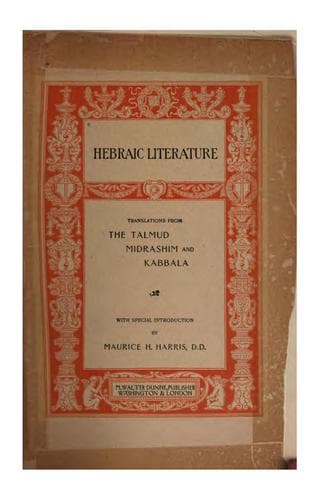
Hebraic Literature; Translations from the Talmud, Midrashim and Kabbala
Religion
Hebraic Literature; Translations from the Talmud, Midrashim and Kabbala
Hebrew literature -- Translations into English
_Bava Bathra_, fol. 9, col. 2.
On the next page of the same tract it is said, "For one prutah
given as alms to a poor man one is made partaker of the beatific
vision." (See also Midrash Tillim on Ps. xvii. 15.)
The prutah was the smallest coin then current. It is estimated
to have been equal to about one-twentieth of an English penny.
In some quarters of Poland the Jews have small thin bits of
brass, with the Hebrew word prutah impressed upon them, for the
uses in charity on the part of those among them that cannot
afford to give a kreutzer to a poor man. The poor, when they
have collected a number of these, change them into larger coin
at the almoner's appointed by the congregation. Thus even the
poor are enabled to give alms to the poor. (See my "Genesis," p.
277, No. 31.)
Rabbi Yochanan said eleven sorts of spices were mentioned to Moses on
Sinai. Rav Hunna asked, "What Scripture text proves this?" (Exod. xxx.
34), "Take unto thee sweet spices" (the plural implying two), "stacte,
myrrh, and galbanum" (these three thus making up five), "sweet spices"
(the repetition doubling the five into ten), "with pure frankincense"
(which makes up eleven).
_Kerithoth_, fol. 6, col. 2.
"Zion said, The Lord hath forsaken and forgotten me" (Isa. xlix. 14).
The community of Israel once pleaded thus with the Holy One--blessed be
He!--"Even a man who marries a second wife still bears in mind the
services of the first, but Thou, Lord, hast forgotten me." The Holy
One--blessed be He!--replied, "Daughter, I have created twelve
constellations in the firmament, and for each constellation I have
created thirty armies, and for each army thirty legions, each legion
containing thirty divisions, each division thirty cohorts, each cohort
having thirty camps, and in each camp hang suspended 365,000 myriads of
stars, as many thousands of myriads as there are days in the year; all
these have I created for thy sake, and yet thou sayest, 'Thou hast
forsaken and forgotten me!' Can a woman forget her sucking-child, that
she should not have compassion on the son of her womb? Yea, they may
forget, yet will I not forget thee."
_Berachoth_, fol. 32, col. 2.
No deceased person is forgotten from the heart (of his relatives that
survive him) till after twelve months, for it is said (Ps. xxxi. 12), "I
am forgotten as a dead man out of mind; I am like a lost vessel" (which,
as Rashi explains, is like all lost property, not thought of as lost for
twelve months, for not till then is proclamation for it given up).
Ibid., fol. 58, col. 2.
Public-domain text, read in full here on John Shaqi.
Reviews
Reviews
No reviews yet
Be the first to share your thoughts on this work.
Elsewhere in the archive
Join the Discussion
Join the discussion
Sign in to leave a comment or review.
Sign InorCreate an account