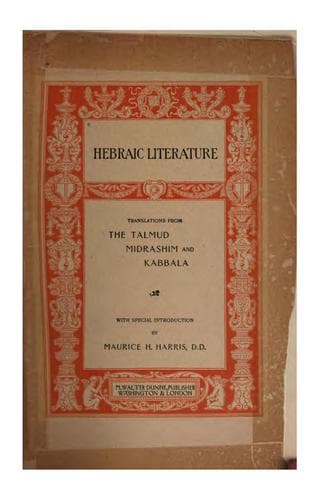
Hebraic Literature; Translations from the Talmud, Midrashim and Kabbala
Religion
Hebraic Literature; Translations from the Talmud, Midrashim and Kabbala
Hebrew literature -- Translations into English
Hereto hangs a tale stranger than fiction, yet founded on fact.
Rabbi Akiva was once a poor shepherd in the employ of Calba
Shevua, one of the richest men in all Jerusalem. While engaged
in that lowly occupation his master's only daughter fell in love
with him, and the two carried on a clandestine courtship for
some time together. Her father, hearing of it, threatened to
disinherit her, to turn her out of doors and disown her
altogether, if she did not break off her engagement. How could
she connect herself with one who was the base-born son of a
proselyte, a reputed descendant of Sisera and Jael, an ignorant
fellow that could neither read nor write, and a man old enough
to be her father? Rachel--for that was her name--determined to
be true to her lover, and to brave the consequences by marrying
him and exchanging the mansion of her father for the hovel of
her husband. After a short spell of married life she prevailed
upon her husband to leave her for a while in order to join a
certain college in a distant land, where she felt sure that his
talents would be recognized and his genius fostered into
development worthy of it. As he sauntered along by himself he
began to harbor misgivings in his mind as to the wisdom of the
step, and more than once thought of returning. But when musing
one day at a resting-place a waterfall arrested his attention,
and he remarked how the water, by its continual dropping, was
wearing away the solid rock. All at once, with the tact for
which he was afterward so noted, he applied the lesson it
yielded to himself. "So may the law," he reasoned, "work its way
into my hard and stony heart;" and he felt encouraged and
pursued his journey. Under the tuition of Rabbi Eliezer, the son
of Hyrcanus, and Rabbi Yehoshua, the son of Chananiah, his
native ability soon began to appear, his name became known to
fame, and he rose step by step until he ranked as a professor in
the very college which he had entered as a poor student. After
some twelve years of hard study and diligent service in the law
he returned to Jerusalem, accompanied by a large number of
disciples. On nearing the dwelling of his devoted wife he caught
the sound of voices in eager conversation. He paused awhile and
listened at the door, and overheard a gossiping neighbor blaming
Rachel for her _mésalliance_, and twitting her with marrying a
man who could run away and leave her as a widow for a dozen of
years or more on the crazy pretext of going to college. He
listened in eager curiosity, wondering what the reply would be.
To his surprise, he heard his self-sacrificing wife exclaim,
"Would that my husband were here and could listen to me; I
should permit, nay, urge him to stay other twelve years, if it
would benefit him." Strange to say Akiva taking the hint from
Public-domain text, read in full here on John Shaqi.
Reviews
Reviews
No reviews yet
Be the first to share your thoughts on this work.
Elsewhere in the archive
Join the Discussion
Join the discussion
Sign in to leave a comment or review.
Sign InorCreate an account