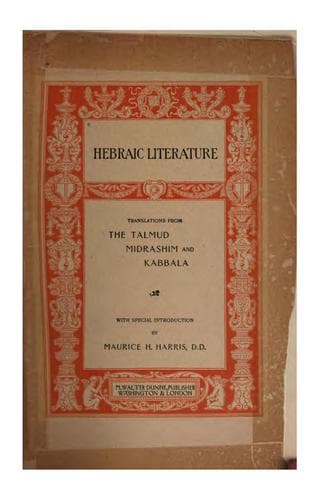
Hebraic Literature; Translations from the Talmud, Midrashim and Kabbala
Religion
Hebraic Literature; Translations from the Talmud, Midrashim and Kabbala
Hebrew literature -- Translations into English
his wife, turned away and left Jerusalem without ever seeing
her. He went abroad again for a time, and then returned for
good; this time, so the story says, with twice twelve thousand
disciples. Well-nigh all Jerusalem turned out to do him honor,
every one striving to be foremost to welcome him. Calba Shevua,
who for many a long year had repented of his hasty resolution,
which cost him at once his daughter and his happiness, went to
Akiva to ask his opinion about annulling this vow. Akiva replied
by making himself known as his quondam servant and rejected
son-in-law. As we may suppose, the two were at once reconciled,
and Calba Shevua looked upon himself as favored of Heaven above
all the fathers in Israel.
The Rabbis say that at first they used to communicate the Divine name of
twelve letters to every one. But when the Antinomians began to abound,
the knowledge of this name was imparted only to the more discreet of the
priestly order, and they repeated it hastily while the other priests
pronounced the benediction of the people. (What the name was, says
Rashi, is not known.) Rabbi Tarphon, the story goes on to say, once
listened to the high priest, and overheard him hurriedly pronouncing
this name of twelve letters while the other priests were blessing the
people.
_Kiddushin_, fol. 71, col. 1.
Twelve hours there are in the day:--The first three, the Holy
One--blessed be He!--employs in studying the law; the next three He sits
and judges the whole world; the third three He spends in feeding all the
world; during the last three hours He sports with the leviathan; as it
is said (Ps. civ. 26), "This leviathan Thou hast created to play with
it."
_Avodah Zarah_, fol. 3, col. 2.
Rabbi Yochanan bar Chanena said:--The day consists of twelve hours.
During the first hour Adam's dust was collected from all parts of the
world; during the second it was made into a lump; during the third his
limbs were formed; during the fourth his body was animated; during the
fifth he stood upon his legs; during the sixth he gave names to the
animals; during the seventh he associated with Eve; during the eighth
Cain and a twin sister were born (Abel and his twin sister were born
after the Fall, says the Tosephoth); during the ninth Adam was ordered
not to eat of the forbidden tree; during the tenth he fell, during the
eleventh he was judged; and during the twelfth he was ejected from
paradise; as it is said (Ps. xlix. 13, A.V. 12), "Man (Adam) abode not
one night in his dignity."
_Sanhedrin_, fol. 38, col. 2.
Rabbi Akiva used to say:--Of five judgments, some have lasted twelve
months, others will do so;--those of the deluge, of Job, of the
Egyptians, of Gog and Magog, and of the wicked in Gehenna.
_Edioth_, chap. 2, mish. 10.
Public-domain text, read in full here on John Shaqi.
Reviews
Reviews
No reviews yet
Be the first to share your thoughts on this work.
Elsewhere in the archive
Join the Discussion
Join the discussion
Sign in to leave a comment or review.
Sign InorCreate an account