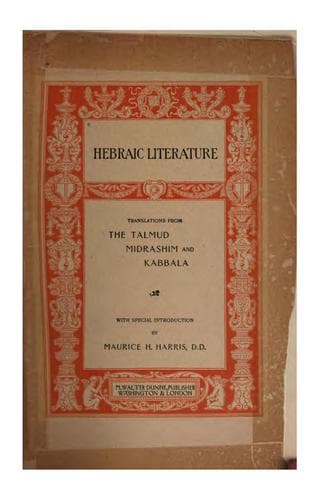
Hebraic Literature; Translations from the Talmud, Midrashim and Kabbala
Religion
Hebraic Literature; Translations from the Talmud, Midrashim and Kabbala
Hebrew literature -- Translations into English
Plagues come upon those that are proud, as was the case with Uzziah (2
Chron. xxvi. 16), "But when he was strong (proud), his heart was lifted
up to destruction." When the leprosy rose up in his forehead, the Temple
was cleft asunder twelve miles either way.
_Avoth d'Rab. Nathan_, chap. 9.
This hyperbole is evidently a mere fiction joined on to a truth
for the purpose of frightening the proud into humility. The end
sanctifieth the means, as we well know from other instances
recorded in the Talmud.
Those who mourn for deceased relatives are prohibited from entering a
tavern for thirty days, but those who mourn for either father or mother
must not do so for twelve months.
_Semachoth_, chap. 9.
A creature that has no bones in his body does not live more than twelve
months.
_Chullin_, fol. 58, col. 1.
The Alexandrians asked Rabbi Joshua twelve questions; three related to
matters of wisdom, three to matters of legend, three were frivolous, and
three were of a worldly nature--viz, how to grow wise, how to become
rich, and how to ensure a family of boys.
_Niddah_, fol. 69, col. 2.
There was once a man named Joseph, who was renowned for honoring the
Sabbath-day. He had a rich neighbor, a Gentile, whose property a certain
fortune-teller had said would eventually revert to Joseph the
Sabbatarian. To frustrate this prediction the Gentile disposed of his
property, and with the proceeds of the sale he purchased a rare and
costly jewel which he fixed to his turban. On crossing a bridge a gust
of wind blew his turban into the river and a fish swallowed it. This
fish being caught, was brought on a Friday to market, and, as luck would
have it, it was bought by Joseph in honor of the coming Sabbath. When
the fish was cut up the jewel was found, and this Joseph sold for
thirteen purses of gold denarii. When his neighbor met him, he
acknowledged that he who despised the Sabbath the Lord of the Sabbath
would be sure to punish.
_Shabbath_, fol. 119, col. 1.
Public-domain text, read in full here on John Shaqi.
Reviews
Reviews
No reviews yet
Be the first to share your thoughts on this work.
Elsewhere in the archive
Join the Discussion
Join the discussion
Sign in to leave a comment or review.
Sign InorCreate an account