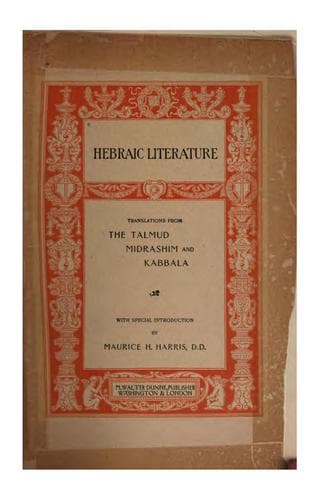
Hebraic Literature; Translations from the Talmud, Midrashim and Kabbala
Religion
Hebraic Literature; Translations from the Talmud, Midrashim and Kabbala
Hebrew literature -- Translations into English
Yochanan says, "The words of the scribes are more highly valued
than the words of the law, for, as Rabbi Yuda remarks, 'If Rabbi
Tarphon had not read the Shema at all he would only have broken
a positive command,' but since he transgressed the rule of
Hillel he was guilty of death, for it is written, 'He who breaks
down a hedge (the Rabbinic hedge to the law, of course), a
serpent shall bite him'" (Eccles. x. 8). Then Rabbi Chanina, the
son of Rabbi Ana, in the name of Rabbi Tanchum, the son of Rabbi
Cheyah, says, "The words of the elders are more important than
the words of the prophets." A prophet and an elder, whom do they
resemble? They are like two ambassadors sent by a king to a
province. About the one he sends word saying, "If he does not
present credentials with my signature and seal, trust him not;"
whereas the other is accredited without any such token; for in
regard to the prophet it is written (Deut. xiii. 2), "He giveth
thee a sign or token;" while in reference to the elders it is
written (Deut. xvii. 11), "According to the decision which they
may say unto thee shalt thou do; thou shalt not depart from the
sentence which they may tell thee, to the right or to the left."
Rashi's comment on this text is worth notice: "Even when they
tell thee that right is left and left is right." In a word, a
wise man (i.e., a Rabbi) is better than a prophet. (_Bava
Bathra_ fol. 12, col. 1.)
Oved, the Galilean, has expounded that there are thirteen _vavs_ (i.e.,
the letter _vav_ occurs thirteen times) in connection with wine. _Vav_
in Syriac means woe.
_Sanhedrin_ fol. 70, col. 1.
The Rabbis have a curious Haggada respecting the origin of the
culture of the vine. Once while Noah was hard at work breaking
up the fallow ground for a vineyard, Satan drew near and
inquired what he was doing. On ascertaining that the patriarch
was about to cultivate the grape, which he valued both for its
fruit and its juice, he at once volunteered to assist him at his
task, and began to manure the soil with the blood of a lamb, a
lion, a pig, and a monkey. "Now," said he, when his work was
done, "of those who taste the juice of the grape, some will
become meek and gentle as the lamb, some bold and fearless as
the lion, some foul and beastly as the pig, and others
frolicsome and lively as the monkey." This quaint story may be
found more fully detailed in the Midrash Tanchuma (see Noah) and
the Yalkut on Genesis. The Mohammedan legend is somewhat
similar. It relates how Satan on the like occasion used the
blood of a peacock, of an ape, of a lion, and of a pig, and it
deduces from the abuse of the vine the curse that fell on the
children of Ham, and ascribes the color of the purple grape to
the dark hue which thenceforth tinctured all the fruit of their
land as well as their own complexions.
Public-domain text, read in full here on John Shaqi.
Reviews
Reviews
No reviews yet
Be the first to share your thoughts on this work.
Elsewhere in the archive
Join the Discussion
Join the discussion
Sign in to leave a comment or review.
Sign InorCreate an account