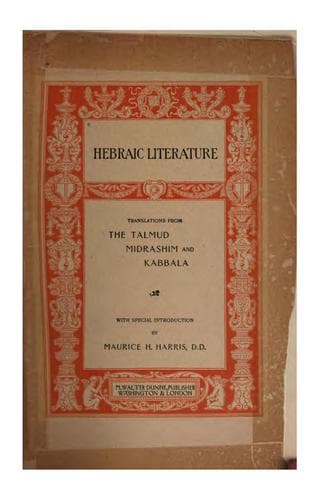
Hebraic Literature; Translations from the Talmud, Midrashim and Kabbala
Religion
Hebraic Literature; Translations from the Talmud, Midrashim and Kabbala
Hebrew literature -- Translations into English
At thirteen years of age, a boy becomes bound to observe the (613)
precepts of the law.
_Avoth_, chap. 5.
Rabbi Ishmael says the law is to be expounded according to thirteen
logical rules.
_Chullin_, fol. 63, col. 1.
The thirteen rules of Rabbi Ishmael above referred to are not to
be found together in any part of the Talmud, but they are
collected for repetition in the Liturgy, and are as follows:--
1. Inference is valid from minor to major.
2. From similar phraseology.
3. From the gist or main point of one text to that of other
passages.
4. Of general and particular.
5. Of particular and general.
6. From a general, or a particular and a general, the ruling
both of the former and the latter is to be according to the
middle term, i.e., the one which is particularized.
7. From a general text that requires a particular instance, and
_vice versà_.
8. When a particular rule is laid down for something which has
already been included in a general law, the rule is to apply to
all.
9. When a general rule has an exception, the exception mitigates
and does not aggravate the rule.
10. When a general rule has an exception not according
therewith, the exception both mitigates and aggravates.
11. When an exception to a general rule is made to substantiate
extraneous matter, that matter cannot be classed under the said
general rule, unless the Scripture expressly says so.
12. The ruling is to be according to the context, or to the
general drift of the argument.
13. When two texts are contradictory, a third is to be sought
that reconciles them.
Rabbi Akiva was forty years of age when he began to study, and after
thirteen years of study he began publicly to teach.
_Avoth d'Rab. Nathan._
Thirteen treasurers and seven directors were appointed to serve in the
Temple. (More there might be, never less.)
_Tamid_, fol. 27, col. 1.
Thirteen points of law regulate the decisions that require to be made
relative to the carcass of a clean bird.
_Taharoth_, chap. i, mish. 1.
A man must partake of fourteen meals in the booth during the Feast of
Tabernacles.
_Succah_, fol. 27, col. 1.
Traditional chronology records that the Israelites killed the Paschal
lamb on the fourteenth day of Nisan, the month on which they came out of
Egypt. They came out on the fifteenth; that day was a Friday.
_Shabbath_, fol. 88, col. 1.
Public-domain text, read in full here on John Shaqi.
Reviews
Reviews
No reviews yet
Be the first to share your thoughts on this work.
Elsewhere in the archive
Join the Discussion
Join the discussion
Sign in to leave a comment or review.
Sign InorCreate an account