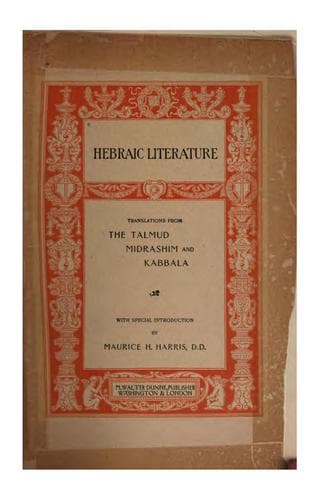
Hebraic Literature; Translations from the Talmud, Midrashim and Kabbala
Religion
Hebraic Literature; Translations from the Talmud, Midrashim and Kabbala
Hebrew literature -- Translations into English
Rabbi Elazar the Great said, "From the fifteenth of Ab the influence of
the sun declines, and from that day they leave off cutting wood for the
altar fire, because it could not be properly dried (and green wood might
harbor vermin, which would make it unfit for use)."
_Taanith_, fol. 31, col. 1.
He who eats turnips to beef, and sleeps out in the open air during the
night of the fourteenth and fifteenth days of the months of summer (that
is, when the moon is full), will most likely bring on an ague fever.
_Gittin_, fol. 70, col. 1.
A lad should, at the age of fifteen, begin to apply himself to the
Gemara.
_Avoth_, chap. 5.
"So I bought her to me for fifteen" (Hosea iii. 2), that is, on the
fifteenth day of Nisan, when Israel was redeemed from the bondage of
Egypt. "Silver;" this refers to the righteous. "An homer and a
half-homer;" these equal forty-five measures, and are the forty-five
righteous men for whose sake the world is preserved. I don't know
whether there are thirty here (that is, in Babylon), and fifteen in the
land of Israel, or _vice versà_; as it is said (Zech. xi. 13), "I took
the thirty pieces of silver and cast them to the potter in the house of
the Lord." It stands to reason that there are thirty in the land of
Israel, and, therefore, fifteen here. Abaii says that the greater part
are to be found under the gable end of the synagogue. Rav Yehudah says
the reference is to the thirty righteous men always found among the
nations of the world for whose sake they are preserved (but see No. 103
_infra_). Ulla says it refers to the thirty precepts received by the
nations of the world, of which, however, they keep three only; i.e. they
do not enter into formal marriage-contracts with men; they do not expose
for sale the bodies of such animals as have died from natural causes;
and they have regard for the law.
_Chullin_, fol. 92, col. 1.
Rabbi Cheyah bar Abba says, "I once visited a house-holder at Ludkia,
and they placed before him a golden table so loaded with silver plate,
basins, cups, bottles and glasses, besides all sorts of dishes,
delicacies, and spices, that it took sixteen men to carry it. When they
set the table in its place they said (Ps. xxiv. 1), 'The earth is the
Lord's and the fullness thereof,' and upon removing it, they said (Ps.
cxv. 16), 'The heaven, even the heavens, are the Lord's, but the earth
hath He given to the children of men.' I said, 'Son, how hast thou come
to deserve all this?' 'I was,' replied he, 'a butcher by trade, and I
always set apart for the Sabbath the best of the cattle.' 'How happy art
thou,' I remarked (adds Rabbi Cheyah), 'to have merited such a reward,
and blessed be God who has thus rewarded thee.'"
_Shabbath_, fol. 119, col. 1.
Rash Lakish said, "I have seen the flow of milk and honey at Tzipori; it
was sixteen miles by sixteen miles."
_Meggillah_, fol. 6, col. 1.
Public-domain text, read in full here on John Shaqi.
Reviews
Reviews
No reviews yet
Be the first to share your thoughts on this work.
Elsewhere in the archive
Join the Discussion
Join the discussion
Sign in to leave a comment or review.
Sign InorCreate an account