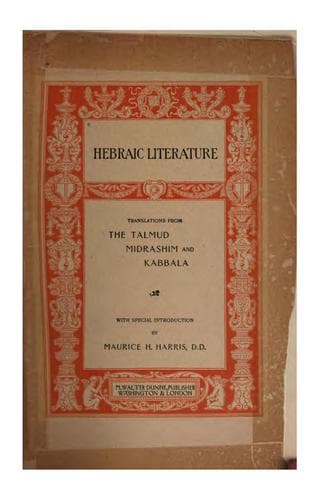
Hebraic Literature; Translations from the Talmud, Midrashim and Kabbala
Religion
Hebraic Literature; Translations from the Talmud, Midrashim and Kabbala
Hebrew literature -- Translations into English
The fifteen steps were according to the number of the Songs of Degrees
in the Psalms. It is related that whosoever has not seen the joy at the
annual ceremony of the water-drawing, has not seen rejoicing in his
life. At the conclusion of the first part of the Feast of Tabernacles,
the Priests and Levites descended into the women's ante-court, where
they made great preparations (such as erecting temporary double
galleries, the uppermost for women, and those under for men). There were
golden candelabra there, each having four golden bowls on the top, four
ladders reaching to them, and four of the young priests with cruses of
oil ready to supply them, each cruse holding one hundred and twenty logs
of oil. The lamp-wicks were made of the worn-out drawers and girdles of
the priests. There was not a court in all Jerusalem that was not lit up
by the illumination of the "water-drawing." Holy men, and men of
dignity, with flaming torches in their hands, danced before the people,
rehearsing songs and singing praises. The Levites, with harps, lutes,
cymbals, trumpets, and innumerable musical instruments, were stationed
on the fifteen steps which led from the ante-court of Israel to the
women's court; the Levites stood upon the steps and played and sang. Two
priests stood at the upper gate which led from the ante-court for Israel
to that for the women, each provided with a trumpet, and as soon as the
cock crew they blew one simple blast, then a compound or fragmentary
one, and then a modulated or shouting blast. This was the preconcerted
signal for the drawing of the water. As soon as they reached the tenth
step, they blew again three blasts as before. When they came to the
ante-court for women, they blew another three blasts, and after that
they continued blowing till they came to the east gate. When they
arrived at the east gate, they turned their faces westward (i.e., toward
the Temple), and said, "Our fathers, who were in this place, turned
their backs toward the Temple of the Lord, and their faces toward the
East, for they worshiped the sun in the East; but we turn our eyes to
God!" Rabbi Yehudah says, "These words were repeated, echoing, 'We are
for God, and unto God are our eyes directed!'"
_Succah_, fol. 51, col. 1, 2.
Rabbon Shimon ben Gamliel has said there were no such gala-days for
Israel as the fifteenth of Ab and the Day of Atonement, when the young
maidens of Jerusalem used to resort to the vineyard all robed in white
garments, that were required to be borrowed, lest those should feel
humiliated who had none of their own. There they danced gleefully,
calling to the lookers-on and saying, "Young men, have a care; the
choice you now make may have consequences."
_Taanith_, fol. 26, col. 2.
Public-domain text, read in full here on John Shaqi.
Reviews
Reviews
No reviews yet
Be the first to share your thoughts on this work.
Elsewhere in the archive
Join the Discussion
Join the discussion
Sign in to leave a comment or review.
Sign InorCreate an account