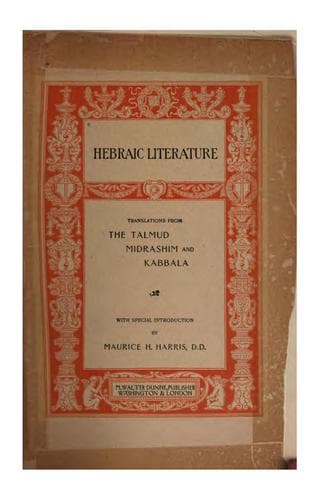
Hebraic Literature; Translations from the Talmud, Midrashim and Kabbala
Religion
Hebraic Literature; Translations from the Talmud, Midrashim and Kabbala
Hebrew literature -- Translations into English
The "imprecation against the Sadducees" stands twelfth among the
collects of the Shemoneh Esreh. It is popularly known as
"Velama-leshinim" from its opening words, and is given thus in
modern Ashkenazi liturgies:--"Oh, let the slanderers have no
hope, all the wicked be annihilated speedily, and all the
tyrants be cut off, hurled down and reduced speedily; humble
Thou them quickly in our days. Blessed art Thou, O Lord, who
destroyest enemies and humblest tyrants." There has been much
misconception with regard to this collect against heretics.
There is every reason to believe it was composed without any
reference whatever to the Christians. One point of interest,
however, in connection with it is worth relating here. Some have
sought to identify the author of it, Samuel the Little, with the
Apostle Paul, grounded the conclusion on his original Hebrew
name, Saul. They take Paulus as equal to _pusillus_, which means
"very little" or "the less," and answers to the word _Hakaton_,
a term of similar import. Samuel, however, died a good Jew (see
Semachoth, chap. 8), and Rabbon Gamliel Hazaken and Rabbi
Eleazar ben Azariah pronounced a funeral oration at his burial.
"His key and his diary were placed on his coffin, because he had
no son to succeed him." (See also Sanhedrin, fol. ii, col. 1.)
Eighteen denunciations did Isaiah make against the people of Israel, and
he recovered not his equanimity until he was able to add, "The child
shall behave himself proudly against the ancient, and the base against
the honorable" (Isa. iii. 5).
_Chaggigah_, fol. 14, col. 1.
The Rabbis have related that there was once a family in Jerusalem the
members of which died off regularly at eighteen years of age. Rabbi
Yochanan ben Zacchai shrewdly guessed that they were descendants of Eli,
regarding whom it is said (1 Sam. ii. 25), "And all the increase of
thine house shall die in the flower of their age;" and he accordingly
advised them to devote themselves to the study of the law, as the
certain and only means of neutralizing the curse. They acted upon the
advice of the Rabbi; their lives were in consequence prolonged; and they
thenceforth went by the name of their spiritual father.
_Rosh Hashanah_, fol. 18, col. 1.
Eighteen handbreadths was the height of the golden candlestick.
_Menachoth_, fol. 28, col. 2.
If a man remain unmarried after the age of twenty, his life is a
constant transgression. The Holy One--blessed be He!--waits until that
period to see if one enters the matrimonial state, and curses his bones
if he remain single.
_Kiddushin_, fol. 29, col. 2.
A woman marrying under twenty years of age will bear till she is sixty;
if she marries at twenty she will bear until she is forty; if she
marries at forty she will not have any family.
_Bava Bathra_, fol. 119, col. 2.
At twenty pursue the study of the law.
_Avoth_, chap. 5.
Public-domain text, read in full here on John Shaqi.
Reviews
Reviews
No reviews yet
Be the first to share your thoughts on this work.
Elsewhere in the archive
Join the Discussion
Join the discussion
Sign in to leave a comment or review.
Sign InorCreate an account