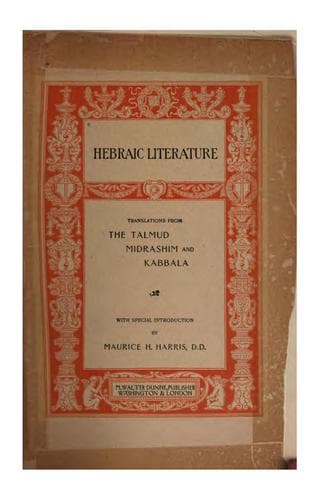
Hebraic Literature; Translations from the Talmud, Midrashim and Kabbala
Religion
Hebraic Literature; Translations from the Talmud, Midrashim and Kabbala
Hebrew literature -- Translations into English
In twenty-four places priests are called Levites, and this is one of
them (Ezek. xliv. 15), "But the priests, the Levites, the sons of
Zadok."
_Tamid_, fol. 27, col. 1.
There are twenty-four extremities of members in the human body which do
not suffer defilement in the case of diseased flesh (see Lev. xiii. 10,
24). The tip-ends of the fingers and toes, the edges of the ears, the
tip of the nose, etc.
_Negaim_, chap. 6, mish. 7.
Twenty-five children is the highest number there should be in a class
for elementary instruction. There should be an assistant appointed, if
there be forty in number; and if fifty, there should be two competent
teachers. Rava says, "If there be two teachers in a place, one teaching
the children more than the other, the one that teaches less is not to be
dismissed, because if so, the other is liable to lapse into negligence
also." Rav Deimi of Nehardaa, on the other hand, thinks the dismissal of
the former will make the latter all the more eager to teach more, both
out of fear lest he also be dismissed, and out of gratitude that he has
been preferred to the other. Mar says, "The emulation of the scribes (or
teachers) increaseth wisdom." Rava also says, "When there are two
teachers, one teaching much but superficially, and one teaching
thoroughly but not so much, the former is to be preferred, for the
children will, in the long run, improve most by learning much." Rav
Deimi of Nehardaa, however, thinks the latter is to be preferred, for a
mistake or an error once learned is difficult to unlearn; as it is
written in 1 Kings xi. 16, "For six months did Joab remain there with
all Israel, until he cut off every male in Edom." When David asked Joab
why he killed only the males and not the females, he replied, "Because
it is written in Deut. xxv. 19, 'Thou shalt blot out the male portion of
Amalek.'" "But," said David, "we read 'the remembrance of Amalek.'" To
this Joab replied, "My teacher taught me to read zachar and not
zeichar," i.e., male, and not remembrance. The teacher of Joab was sent
for; and being found guilty of having taught his pupil in a superficial
manner, he was condemned to be beheaded. The poor teacher pleaded in
vain for his life, for the king's judgment was based on Scripture (Jer.
xlviii. 10), "Cursed be he that doeth the work of the Lord deceitfully,
and cursed be he that keepeth back his sword from blood."
_Bava Bathra_, fol. 21, col. 1.
The Romans faithfully observed their compact with Israel for twenty-six
years. After that time they began to oppress them.
_Avoda Zarah_, fol. 8, col. 2.
The Rabbis have taught that a small salt fish will cause death if
partaken of after seven, seventeen, or twenty-seven days; some say after
twenty-three days. This is said with reference to half-cooked fish, but
when properly cooked there is no harm in it. Neither does any harm
result from eating half-cooked fish, if strong drink be taken after it.
_Berachoth_, fol. 44, col. 2.
Public-domain text, read in full here on John Shaqi.
Reviews
Reviews
No reviews yet
Be the first to share your thoughts on this work.
Elsewhere in the archive
Join the Discussion
Join the discussion
Sign in to leave a comment or review.
Sign InorCreate an account