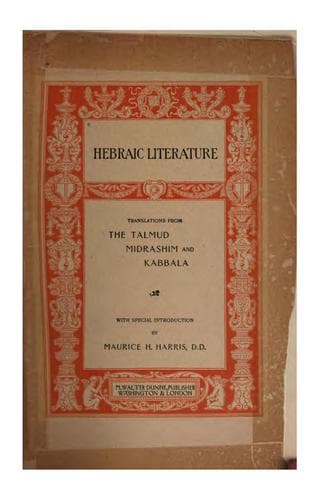
Hebraic Literature; Translations from the Talmud, Midrashim and Kabbala
Religion
Hebraic Literature; Translations from the Talmud, Midrashim and Kabbala
Hebrew literature -- Translations into English
When Rav Deimi arrived at Babylon, he reported that the Romans had
fought thirty-two battles with the Greeks without once conquering them,
until they allied themselves with Israel, on the stipulation that where
Rome appointed the commanding officers the Jews should appoint the
governors, and _vice versâ_.
_Avodah Zarah_, fol. 8, col. 2.
Manasseh did penance thirty-three years.
_Sanhedrin_, fol. 103, col. 1.
Balaam was thirty-three years of age when Phineas, the robber, slew him.
Ibid., fol. 106, col. 2.
For thirty-four years the kingdom of Persia lasted contemporaneously
with the Temple.
_Avodah Zarah_, fol. 9, col. 1.
Abaii has said, "There are never fewer than thirty-six righteous men in
every generation who receive the presence of the Shechinah; for it is
said (Isa. xxx. 18), 'Blessed are all those who wait upon Him.'" The
numerical value (by Gematria) of Him, is thirty-six.
_Sanhedrin_, fol. 97, col. 2.
The sons of Esau, of Ishmael, and of Keturah went on purpose to dispute
the burial (of Jacob); but when they saw that Joseph had placed his
crown upon the coffin, they did the same with theirs. There were
thirty-six crowns in all, tradition says. "And they mourned with a great
and very sore lamentation." Even the very horses and asses joined in it,
we are told. On arriving at the Cave of Machpelah, Esau once more
protested, and said, "Adam and Eve, Abraham and Sarah, Isaac and
Rebekah, are all buried here. Jacob disposed of his share when he buried
Leah in it, and the remaining one belongs to me." "But thou didst sell
thy share with thy birthright," remonstrated the sons of Jacob. "Nay,"
rejoined Esau, "that did not include my share in the burial-place."
"Indeed it did," they argued, "for our father, just before he died, said
(Gen. l. 5), 'In my grave which I have bought for myself.'" "Where are
the title-deeds?" demanded Esau. "In Egypt," was the answer. And
immediately the swift-footed Naphthali started for the records. ("So
light of foot was he," says the Book of Jasher, "that he could go upon
the ears of corn without crushing them.") Hushim, the son of Dan, being
deaf, asked what was the cause of the commotion. On being told what it
was, he snatched up a club and smote Esau so hard that his eyes dropped
out and fell upon the feet of Jacob; at which Jacob opened his eyes and
grimly smiled. This is that which is written (Ps. lviii. 10), "The
righteous shall rejoice when he sees vengeance; he shall wash his feet
in the blood of the wicked." Then Rebekah's prophecy came to pass (Gen.
xxvii. 45), "Why shall I be deprived also of you both in one day?" For
although they did not both die on the same day, they were both buried on
the same day.
_Soteh_, fol. 13, col. 1.
This story slightly varied, is repeated in the Book of Jasher
and in the Targum of Ben Uzziel.
Public-domain text, read in full here on John Shaqi.
Reviews
Reviews
No reviews yet
Be the first to share your thoughts on this work.
Elsewhere in the archive
Join the Discussion
Join the discussion
Sign in to leave a comment or review.
Sign InorCreate an account